


Page 99 - GHES-2-2
P. 99
Global Health Econ Sustain                                          COVID-19 vaccine uptake in Kwara State


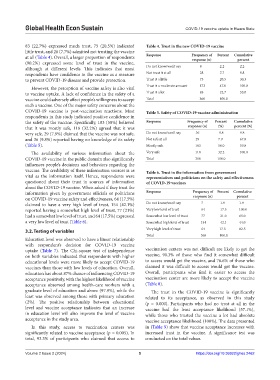
            83  (22.7%) expressed much trust, 75  (20.5%) indicated   Table 4. Trust in the new COVID‑19 vaccine
            little trust, and 28 (7.7%) admitted not trusting the vaccine
            at all (Table 4). Overall, a larger proportion of respondents   Response  Frequency of   Percent  Cumulative
                                                                                                      percent
                                                                                   response (n)
            (90.2%) expressed some level of trust in the vaccine,
            although at different levels. This indicates that most   Do not know/won’t say            8     2.2         2.2
            respondents have confidence in the vaccine as a measure   Not trust it at all            28     7.7         9.8
            to prevent COVID-19 disease and provide protection.  Trust it a little            75     20.5         30.3

              However, the perception of vaccine safety is also vital   Trust it a moderate amount  172     47.0  100.0
            to vaccine uptake. A lack of confidence in the safety of a   Trust it a lot            83     22.7         53.0
            vaccine could adversely affect people’s willingness to accept   Total     366     100.0
            such a vaccine. One of the major safety concerns about the
            COVID-19 vaccine is post-vaccination reactions. Most   Table 5. Safety of COVID‑19 vaccine administration
            respondents in this study indicated positive confidence in
            the safety of the vaccine. Specifically, 183 (50%) believed   Response  Frequency of   Percent   Cumulative
            that it was mostly safe, 118  (32.2%) agreed that it was             response (n)  (%)   percent (%)
            very safe, 29 (7.9%) claimed that the vaccine was not safe,   Do not know/won’t say            36       9.8         9.8
            and 36 (9.8%) reported having no knowledge of its safety   Not safe at all            29      7.9         67.8
            (Table 5).                                         Mostly safe          183         50.0         59.8
              The availability of various information about the   Very safe         118         32.2   100.0
            COVID-19 vaccine in the public domain also significantly   Total        366      100.0
            influences people’s decisions and behaviors regarding the
            vaccine. The credibility of these information sources is as   Table 6. Trust in the information from government
            vital as the information itself. Hence, respondents were   representatives and politicians on the safety and effectiveness
            questioned about their trust in sources of information   of COVID‑19 vaccines
            about the COVID-19 vaccine. When asked if they trust the
            information given by government officials or politicians   Response    Frequency of  Percent  Cumulative
            on COVID-19 vaccine safety and effectiveness, 64 (17.5%)               response (n)       percent
            claimed to have a very high level of trust, 154  (42.1%)   Do not know/won’t say             7      1.9          1.9
            reported having a somewhat high level of trust, 77 (21%)   Very low level of trust             64      17.5  100.0
            had a somewhat low level of trust, and 64 (17.5%) expressed   Somewhat low level of trust             77      21.0          65.0
            a very low level of trust (Table 6).               Somewhat high level of trust  154      42.1          44.0

            3.2. Testing of variables                          Very high level of trust             64     17.5          82.5
                                                               Total                  366     100.0
            Education level was observed to have a linear relationship
            with respondent’s decision for COVID-19 vaccine
            uptake (Table 7). The Chi-square test of independence   vaccination centers was not difficult are likely to get the
            on both variables indicated that respondents with higher   vaccine, 90.3% of those who find it somewhat difficult
            educational levels were more likely to accept COVID-19   to access would get the vaccine, and 76.6% of those who
            vaccines than those with low levels of education. Overall,   claimed it was difficult to access would get the vaccine.
            education has about 87% chance of influencing COVID-19   Overall, participants who find it easier to access the
            acceptance positively, with the highest likelihood of vaccine   vaccination center are more likely to accept the vaccine
            acceptance  observed among  health-care workers with  a   (Table 8).
            graduate level of education and above (97.9%), while the   The trust in the COVID-19 vaccine is significantly
            least was observed among those with primary education   related to its acceptance, as observed in this study
            (2%). The positive relationship between educational   (p = 0.000). Participants who had no trust at all in the
            level and vaccine acceptance indicates that an increase   vaccine had the least acceptance likelihood (57.1%),
            in education level will also improve the level of vaccine   while those who trusted the vaccine a lot had absolute
            acceptance in the study area.                      vaccine acceptance likelihood (100%). The data presented
              In this study, access to vaccination centers was   in (Table 9) show that vaccine acceptance increases with
            significantly related to vaccine acceptance (p = 0.005). In   increased trust in  the  vaccine.  A  significance  test  was
            total, 93.3% of participants who claimed that access to   conducted on the total values.


            Volume 2 Issue 2 (2024)                         5                        https://doi.org/10.36922/ghes.2462

