


Page 98 - GHES-2-2
P. 98
Global Health Econ Sustain                                          COVID-19 vaccine uptake in Kwara State


            2.3. Ethical considerations                        a significant level of influence over people’s decisions on

            Approval for this study was obtained from the Kwara State   health-related issues.
            Ministry of Health with the ethics approval code ERC/  Furthermore,  access  to  vaccination  centers  was
            MOH/2021/12/009. Permissions to conduct the study   reported to be relatively easy by a majority of respondents.
            were also sought from the management of each health-  The implication of this is that individuals who are willing
            care facility used. This study incurred no financial costs for   or likely to receive the vaccine are more motivated to
            the subjects, and their information was kept confidential.   visit these centers for vaccination. This would, in turn,
            The  purpose  of  the  investigation  was  explained  to all   increase confidence as well as willingness to get vaccinated.
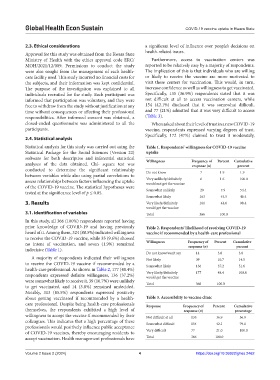
            individuals recruited for the study. Each participant was   Specifically, 135  (36.9%) respondents stated that it was
            informed that participation was voluntary, and they were   not difficult at all to access vaccination centers, while
            free to withdraw from the study without justification at any   154  (42.1%) disclosed that it was somewhat difficult,
            time without consequences or affecting their professional   and 77 (21%) admitted that it was very difficult to access
            responsibilities. After informed consent was obtained, a   (Table 3).
            closed-ended questionnaire was administered to all the   When asked about their level of trust in a new COVID-19
            participants.                                      vaccine, respondents expressed varying degrees of trust.
                                                               Specifically, 172  (47%) claimed to trust it moderately,
            2.4. Statistical analysis
            Statistical analysis for this study was carried out using the   Table 1. Respondents’ willingness for COVID‑19 vaccine
            Statistical Package for the Social Sciences (Version 22)   uptake
            software for both descriptive and inferential statistical   Willingness  Frequency of   Percent  Cumulative
            analyses of the data obtained. Chi-  square test was                   response (n)       percent
            conducted to determine the significant relationship   Do not know                7     1.9         1.9
            between variables while also using partial correlations to
            assess relationships between factors influencing the uptake   Very unlikely/definitely              6     1.6  100.0
                                                               would not get the vaccine
            of the COVID-19 vaccine. The statistical hypotheses were
            tested at the significance level of p ≤ 0.05.      Somewhat unlikely             29      7.9         54.4
                                                               Somewhat likely        163        44.5         46.4
            3. Results                                         Very likely/definitely   161      44.0         98.4
                                                               would get the vaccine
            3.1. Identification of variables                   Total                  366      100.0
            In this study, all 366 (100%) respondents reported having
            prior knowledge of COVID-19 and having previously   Table 2. Respondents’ likelihood of receiving COVID‑19
            heard of it. Among them, 324 (88.5%) indicated willingness   vaccine if recommended by a health‑care professional
            to receive the COVID-19 vaccine, while 35 (9.6%) showed
            no intent of vaccination, and seven (1.9%) remained   Willingness    Frequency of   Percent  Cumulative
                                                                                                      percent
                                                                                 response (n)
            indecisive (Table 1).
                                                               Do not know/won’t say            14      3.8          3.8
              A majority of respondents indicated their willingness   Not likely            39      10.7          14.5
            to receive the COVID-19 vaccine if recommended by a   Somewhat likely   136         37.2          51.6
            health-care professional. As shown in Table 2, 177 (48.4%)
            respondents expressed definite willingness, 136  (37.2%)   Very likely/definitely   177      48.4  100.0
                                                               would get the vaccine
            were somewhat likely to receive it, 39 (10.7%) were unlikely
            to get vaccinated, and 14  (3.8%) remained undecided.   Total           366      100.0
            Notably, 313  (85.5%) respondents expressed positivity
            about  getting  vaccinated  if  recommended  by  a  health-  Table 3. Accessibility to vaccine clinic
            care professional. Despite being health-care professionals   Response  Frequency of   Percent  Cumulative
            themselves, the respondents exhibited a high level of              response (n)          percentage
            willingness to accept the vaccine if recommended by their   Not difficult at all  135      36.9         36.9
            colleagues. This indicates that a high percentage of these   Somewhat difficult  154      42.1         79.0
            professionals would positively influence public acceptance
            of COVID-19 vaccines, thereby encouraging residents to   Very difficult            77      21.0  100.0
            accept vaccination. Health management professionals have   Total      366        100.0


            Volume 2 Issue 2 (2024)                         4                        https://doi.org/10.36922/ghes.2462

