


Page 160 - GHES-2-4
P. 160
Global Health Economics and
            Sustainability
                                                                               Impact of dating violence on mental health


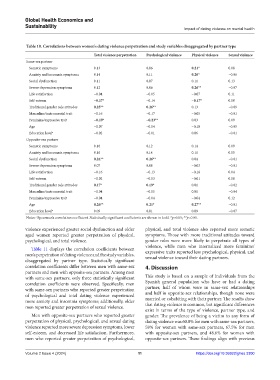
            Table 10. Correlations between women’s dating violence perpetration and study variables disaggregated by partner type
                                         Total violence perpetration  Psychological violence  Physical violence  Sexual violence
            Same-sex partner
             Somatic symptoms            0.13                  0.06                0.21*          0.08
             Anxiety and insomnia symptoms  0.14               0.11                0.20*          −0.06
             Social dysfunction          0.11                  0.07                0.11           0.13
             Severe depression symptoms  0.12                  0.06                0.26**         −0.07
             Life satisfaction           −0.04                 −0.05               −0.07          0.11
             Self-esteem                 −0.17*                −0.14               −0.17*         0.00
             Traditional gender role attitudes  0.25**         0.26**              0.13           −0.09
             Masculine/instrumental trait  −0.16               −0.17               −0.05          −0.01
             Feminine/expressive trait   −0.19*                −0.23**             0.03           0.09
             Age                         −0.07                 −0.04               −0.10          −0.05
             Education level a           −0.02                 −0.01               0.06           −0.01
            Opposite-sex partner
             Somatic symptoms            0.16                  0.12                0.14           0.09
             Anxiety and insomnia symptoms  0.16               0.14                0.11           0.05
             Social dysfunction          0.24**                0.26**              0.04           −0.01
             Severe depression symptoms  0.07                  0.08                −0.03          −0.01
             Life satisfaction           −0.16                 −0.13               −0.16          0.04
             Self-esteem                 −0.02                 −0.03               −0.01          0.08
             Traditional gender role attitudes  0.17*          0.19*               0.01           −0.02
             Masculine/instrumental trait  −0.04               −0.05               0.01           −0.04
             Feminine/expressive trait   −0.04                 −0.04               −0.04          0.12
             Age                         0.26**                0.21*               0.27**         −0.01
             Education level a           0.09                  0.01                0.09           −0.07
            Notes:  Spearman’s correlation coefficient. Statistically significant coefficients are shown in bold. *p<0.05; **p<0.01.
                 a
            violence experienced greater social dysfunction and older   physical, and total violence also reported more somatic
            aged women reported greater perpetration of physical,   symptoms. Those with more traditional attitudes toward
            psychological, and total violence.                 gender roles were more likely to perpetrate all types of
                                                               violence, while men who internalized more feminine/
              Table  11  displays the correlation coefficients between
            men’s perpetration of dating violence and the study variables,   expressive traits reported less psychological, physical, and
                                                               sexual violence toward their dating partners.
            disaggregated  by  partner  type.  Statistically  significant
            correlation coefficients differ between men with same-sex   4. Discussion
            partners and men with opposite-sex partners. Among men
            with same-sex partners, only three statistically significant   This study is based on a sample of individuals from the
            correlation coefficients were observed. Specifically, men   Spanish general population who have or had a dating
            with same-sex partners who reported greater perpetration   partner, half of whom were in same-sex relationships
            of psychological and total dating violence experienced   and half in opposite-sex relationships, though none were
            more anxiety and insomnia symptoms; additionally, older   married or cohabiting with their partner. The results show
                                                               that dating violence is common, but significant differences
            men reported greater perpetration of sexual violence.
                                                               exist in terms of the type of violence, partner type, and
              Men with opposite-sex partners who reported greater   gender. The prevalence of being a victim to any form of
            perpetration of physical, psychological, and sexual dating   dating violence was 60.8% for men with same-sex partners,
            violence reported more severe depression symptoms, lower   59% for women with same-sex partners, 67.5% for men
            self-esteem, and decreased life satisfaction. Furthermore,   with opposite-sex partners, and 48.6% for women with
            men who reported greater perpetration of psychological,   opposite-sex partners. These findings align with previous


            Volume 2 Issue 4 (2024)                         11                       https://doi.org/10.36922/ghes.3300

