


Page 161 - GHES-2-4
P. 161
Global Health Economics and
            Sustainability
                                                                               Impact of dating violence on mental health


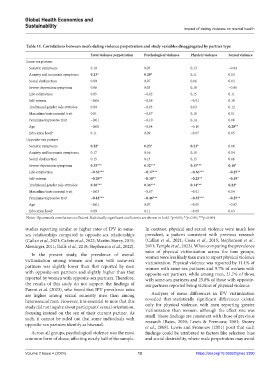
            Table 11. Correlations between men’s dating violence perpetration and study variables disaggregated by partner type
                                        Total violence perpetration  Psychological violence  Physical violence  Sexual violence
            Same-sex partner
             Somatic symptoms           0.10                  0.05                0.13            −0.04
             Anxiety and insomnia symptoms  0.23*             0.20*               0.11            0.03
             Social dysfunction         0.09                  0.07                0.06            0.03
             Severe depression symptoms  0.06                 0.03                0.10            −0.06
             Life satisfaction          0.05                  −0.02               0.15            0.11
             Self-esteem                −0.06                 −0.08               −0.01           0.10
             Traditional gender role attitudes  0.00          −0.03               0.03            0.12
             Masculine/instrumental trait  0.01               −0.07               0.18            0.01
             Feminine/expressive trait  −0.01                 −0.10               0.14            0.06
             Age                        −0.08                 −0.04               −0.10           0.29**
             Education level a          0.11                  0.09                −0.07           0.05
            Opposite-sex partner
             Somatic symptoms           0.22*                 0.23*               0.21*           0.06
             Anxiety and insomnia symptoms  0.17              0.16                0.18            0.04
             Social dysfunction         0.15                  0.13                0.15            0.06
             Severe depression symptoms  0.35***              0.32***             0.35***         0.18*
             Life satisfaction          −0.38***              −0.37***            −0.36***        −0.25**
             Self-esteem                −0.29**               −0.30**             −0.25**         −0.19*
             Traditional gender role attitudes  0.36***       0.34***             0.34***         0.22*
             Masculine/instrumental trait  −0.03              −0.07               −0.01           0.04
             Feminine/expressive trait  −0.42***              −0.46***            −0.35***        −0.25**
             Age                        −0.01                 0.07                −0.05           −0.07
             Education level a          0.09                  0.11                −0.09           0.03
            Notes:  Spearman’s correlation coefficient. Statistically significant coefficients are shown in bold. *p<0.05; **p<0.01; ***p<0.001.
                 a
            studies reporting similar or higher rates of IPV in same-  In contrast, physical and sexual violence were much less
            sex relationships compared to opposite-sex relationships   prevalent, a  pattern  consistent with  previous  research
            (Callan et al., 2021; Cañete et al., 2022; Martin-Storey, 2015;   (Callan et al., 2021; Costa et al., 2015; Stephenson et al.,
            Messinger, 2011; Rollè et al., 2018; Stephenson et al., 2022).  2011; Temple et al., 2023). When comparing the prevalence
                                                               rates of physical victimization across the four groups,
              In the present study, the  prevalence of overall   women were less likely than men to report physical violence
            victimization among women and men with same-sex    victimization. Physical violence was reported by 11.1% of
            partners was slightly lower than that reported by men   women with same-sex partners and 9.7% of women with
            with opposite-sex partners and slightly higher than that   opposite-sex partners, while among men, 21.7% of those
            reported by women with opposite-sex partners. Therefore,   with same-sex partners and 25.8% of those with opposite-
            the results of this study do not support the findings of   sex partners reported being victims of physical violence.
            Parent et al. (2023), who found that IPV prevalence rates
            are higher among sexual minority men than among      Analyses  of mean differences in  IPV  victimization
            heterosexual men. However, it is essential to note that this   revealed that statistically significant differences existed
            study did not inquire about participants’ sexual orientation,   only for physical violence, with men reporting greater
            focusing instead on the sex of their current partner. As   victimization  than  women,  although  the  effect  size  was
            such, it cannot be ruled out that some individuals with   small. These findings are consistent with those of previous
                                                               research (Bates, 2020; Lewis & Fremouw, 2001; Shorey
            opposite-sex partners identify as bisexual.
                                                               et al., 2008). Lewis and Fremouw (2001) posit that such
              Across all groups, psychological violence was the most   findings could be attributed to factors like selection bias
            common form of abuse, affecting nearly half of the sample.   and social desirability, where male perpetrators may avoid


            Volume 2 Issue 4 (2024)                         12                       https://doi.org/10.36922/ghes.3300

