


Page 72 - GHES-2-4
P. 72
Global Health Economics and
            Sustainability
                                                                                Assessing Vietnam’s pandemic lockdown


            administration implemented Directive No.16/CT-TTg    It is important to note that these local governments
            in Buon Man Thuot City, which successfully reduced the   implemented interventions relatively late. For example,
            infection rate, resulting in a slope of −2.06 (p = 0.006).  Binh Duong applied Directive No.16/CT-TTg when the
                                                               number of daily new cases had already reached 503, while
            3.1.5. South-east                                  in HCM City, Directive No.16/CT-TTg was applied on July
            In the South-east region, this study categorized provinces   9, 2021, when there were already 1,729 new daily cases.
            into two groups based on the severity of the pandemic. The   3.1.6. Mekong River Delta
            first group included Ba Ria–Vung Tau, Tay Ninh, and Binh
            Phuoc, while the second group comprised HCM City, Binh   As a neighboring region to the Southeast, the epicenter
            Duong, and Dong Nai.                               of the outbreak, the Mekong River Delta was massively
                                                               impacted when the pandemic escalated in the South-east.
              In the first group, the situation remained under control   To prevent the spread of the coronavirus, all provinces and
            with the province-wide application of the strictest Directive   cities in the Mekong River Delta implemented Directive
            No.16/CT-TTg. During the study period, the number of   No.16/CT-TTg in its strictest form on July 19, 2021 (The
            new infections in these provinces did not exceed 500 cases/  Prime Minister, 2021).
            day. The statistical values for trendline changes in the post-
            intervention periods were all negative. For Ba Ria–Vung   This intervention proved effective in Tra Vinh, Vinh
            Tau, this value was −2.57 (p = 0.1), while in Tay Ninh and   Long,  Ben  Tre,  Dong  Thap,  and  Hau  Giang  provinces.
            Binh Phuoc, the values were −9.98 (p = 0.666) and −0.74   The ITS model results show a negative slope change in the
            (p = 0.74), respectively.                          post-intervention period for these provinces, indicating a
                                                               decline in infection rates. 1
              In contrast, the situation was quite severe in the second
                                                                 A similar pattern was observed in Can Tho, Long
            group. Unlike the localities investigated in the previous   An, and Tien Giang, where the pandemic was gradually
            sections, the province-wide application of Directive No.16/  controlled following the province-wide application of
            CT-TTg  did  not  significantly  impact  Binh  Duong  and   Directive No.16/CT-TTg. However, the effectiveness of this
            Dong Nai, as the slope changes for the post-intervention   intervention was not as pronounced as in the previously
            period continued to increase positively. In Binh Duong,   mentioned provinces. By the end of the study period, the
            the slope change value was 30.1 (p = 0.006), while in Dong   number of daily new infection cases remained relatively
            Nai, it was 9.73 (p = 0.0).                        high in Can Tho (30 cases), Long An (117 cases), and Tien
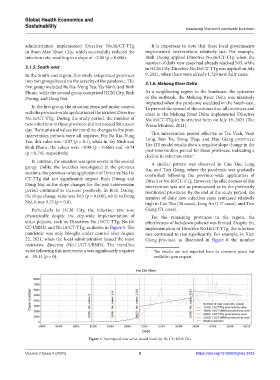
              Particularly in HCM City, the infection rate rose   Giang (71 cases).
            dramatically despite the city-wide implementation of   For the remaining provinces in the region, the
            strict policies, such as Directives No.15/CT-TTg, No.10/  effectiveness of lockdown policies was limited. Despite the
            CT-UBND, and No.16/CT-TTg, as shown in Figure 5. The   implementation of Directive No.16/CT-TTg, the infection
            pandemic  was only brought under control after August   rate continued to rise significantly. For example, in Kien
            22, 2021, when the local administration issued the most   Giang province, as illustrated in  Figure  6, the number
            restrictive directive (No.11/CT-UBND). The trendline
            value following this intervention was significantly negative   1    The results are not reported here to conserve space but
            at −59.14 (p = 0).                                    available upon request.


                                       Figure 5. Interrupted time series model result for Ho Chi Minh City


            Volume 2 Issue 4 (2024)                         8                        https://doi.org/10.36922/ghes.3423

