


Page 199 - GHES-3-2
P. 199
Global Health Economics and
            Sustainability
                                                                                      Gender inequality and healthcare


            3. Results                                         and the second lowest access to anti-retroviral drugs. As
                                                               Africa is predominantly where HIV incidence reports are
            3.1. Gender inequality and preventative health     documented, this  chart suggests a socioeconomic issue
            We analyzed the role of gender in the association between   beyond gender – access to HIV drugs is lowest in the
            different dimensions of preventative healthcare. First, we   countries that need them most, impacting both genders.
            assessed the association between access to anti-retroviral   This is possibly due to poor awareness, limited education,
            drugs (as an aspect of preventative health) and the   and a low standard of living.
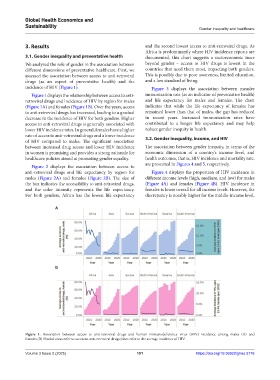
            incidence of HIV (Figure 1).                         Figure  3 displays the association between measles
              Figure 1 displays the relationship between access to anti-  immunization rate (as an indicator of preventative health)
            retroviral drugs and incidence of HIV by region for males   and life expectancy for males and females. The  chart
            (Figure 1A) and females (Figure 1B). Over the years, access   indicates that while the life expectancy of females has
            to anti-retroviral drugs has increased, leading to a gradual   remained lower than that of males, the gap has reduced
            decrease in the incidence of HIV for both genders. Higher   in recent years. Increased immunization rates have
            access to anti-retroviral drugs is generally associated with   contributed to a longer life expectancy and may help
            lower HIV incidence rates. In general, females have a higher   reduce gender inequity in health.
            rate of access to anti-retroviral drugs and a lower incidence
            of HIV compared to males. The significant association   3.2. Gender inequality, income, and HIV
            between increased drug access and lower HIV incidence   The association between gender inequity, in terms of the
            in women is promising and provides a strong rationale for   economic dimension of a country’s income level, and
            healthcare policies aimed at promoting gender equality.  health outcomes, that is, HIV incidence and mortality rate,
              Figure  2 displays the association between access to   are presented in Figures 4 and 5, respectively.
            anti-retroviral drugs and life expectancy by region for   Figure 4 displays the proportion of HIV incidence in
            males  (Figure  2A)  and  females  (Figure  2B).  The  size  of   different income levels (high, medium, and low) for males
            the box indicates the accessibility to anti-retroviral drugs,   (Figure  4A) and females (Figure  4B). HIV incidence in
            and the color intensity represents the life expectancy.   females is lower overall for all income levels. However, the
            For both genders, Africa has the lowest life expectancy   discrepancy is notably higher for the middle-income level,

                         A


                         B


            Figure  1.  Association between access to anti-retroviral drugs and human immunodeficiency virus (HIV) incidence among males (A) and
            females (B) Shaded areas refer to access to anti-retroviral drugs; lines refer to the average incidence of HIV.


            Volume 3 Issue 2 (2025)                        191                       https://doi.org/10.36922/ghes.5776

