


Page 204 - GHES-3-2
P. 204
Global Health Economics and
            Sustainability
                                                                                      Gender inequality and healthcare


                               Figure 10. The proportion of women in parliament and female life expectancy by income level

                                                               awareness, education, and the standard of living is critical.
                                                                 In addition, our findings indicate that greater and
                                                               faster access to drugs and immunization can enhance life
                                                               expectancy and reduce HIV incidences, highlighting the
                                                               need for targeted policy interventions.
                                                                 The lower HIV incidence in females than in males is
                                                               not correlated to a higher income or economic growth, as
                                                               it was observed that HIV incidence is higher in middle-
                                                               income than in low-income countries. In middle-income
                                                               countries, more income does not necessarily translate into
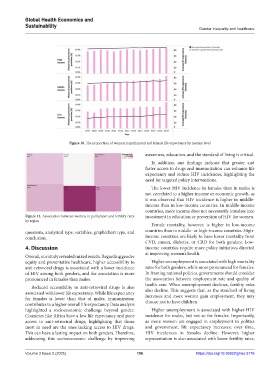
            Figure 11. Association between women in parliament and fertility rates   investment in education or prevention of HIV for women.
            by region
                                                                 Female mortality, however, is higher in low-income
            questions, analytical type, variables, graph/chart type, and   countries than in middle- or high-income countries. High-
            conclusion.                                        income countries are likely to have lower mortality from
                                                               CVD, cancer, diabetes, or CRD for both genders. Low-
            4. Discussion                                      income countries require more policy initiatives directed
                                                               at improving women’s health.
            Overall, our study revealed mixed results. Regarding gender
            equity and preventative healthcare, higher accessibility to   Higher unemployment is associated with high mortality
            anti-retroviral drugs is associated with a lower incidence   rates for both genders, while more pronounced for females.
            of HIV among both genders, and the association is more   In framing national policies, governments should consider
            pronounced in females than males.                  the association between employment rate and quality of
                                                               health care. When unemployment declines, fertility rates
              Reduced accessibility to anti-retroviral drugs is also
            associated with lower life expectancy. While life expectancy   also decline. This suggests that, as the standard of living
                                                               increases and more women gain employment, they may
            for females is lower than that of males, immunization
            contributes to a higher overall life expectancy. Data analysis   choose not to have children.
            highlighted  a  socioeconomic  challenge  beyond  gender.   Higher unemployment is associated with higher HIV
            Countries like Africa have a low life expectancy and poor   incidence for males, but not so for females. Importantly,
            access to anti-retroviral drugs, highlighting that those   as more women are engaged in employment in politics
            most in need are the ones lacking access to HIV drugs.   and government, life expectancy increases; over time,
            This can have a lasting impact on both genders. Therefore,   HIV  incidences  in females decline. However, higher
            addressing this socioeconomic challenge by improving   representation is also associated with lower fertility rates,


            Volume 3 Issue 2 (2025)                        196                       https://doi.org/10.36922/ghes.5776

