


Page 206 - GHES-3-2
P. 206
Global Health Economics and
            Sustainability
                                                                                      Gender inequality and healthcare


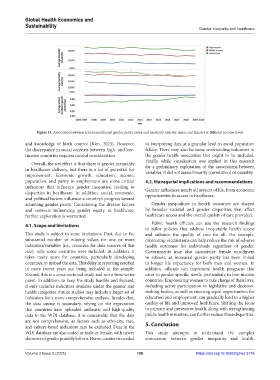
                 Figure 15. Association between school enrollment gender parity index and mortality rates for males and females at different income levels

            and knowledge of birth control (Kim, 2023). However,   in interpreting data at a granular level to avoid population
            the discrepancy in social contexts between high- and low-  fallacy. There may also be some confounding indicators in
            income countries requires careful consideration.   the gender-health association that ought to be included.
                                                               Finally,  while  visualization  was  applied  in  this  research
              Overall, the net effect is that there is gender inequality
            in healthcare delivery, but there is a lot of potential for   for a preliminary exploration of the associations between
            improvement. Economic growth, education, income,   variables, it did not assess linearity (correlation) or causality.
            population, and parity in employment are some critical   4.2. Managerial implications and recommendations
            indicators that influence gender inequities, leading to   Gender influences nearly all aspects of life, from economic
            disparities  in  healthcare.  In addition,  social, economic,   opportunities to access to healthcare.
            and political factors influence a country’s progress toward
            achieving gender parity. Considering the diverse factors   Gender inequalities in health outcomes are shaped
            and contexts influencing gender equity in healthcare,   by  broader  societal  and  gender  disparities  that  affect
            further exploration is warranted.                  healthcare access and the overall quality of care provided.
                                                                 Public health officials can use the research findings
            4.1. Scope and limitations
                                                               to tailor policies that address inequitable health access
            This study is subject to some limitations. First, due to the   and enhance the quality of care for all. For example,
            substantial number of missing values for one or more   promoting vaccinations can help reduce the risk of adverse
            indicators/variables (i.e., common for data sources of this   health outcomes for individuals regardless of gender.
            size), only some countries were included. In addition, it   Governments may also incentivize female enrollment
            takes many years for countries, particularly developing   in  schools, as  increased  gender parity  has been linked
            countries, to upload the data. This delay in reporting resulted   to longer life expectancy for both men and women. In
            in more recent years not being included in the sample.   addition, officials can implement health programs that
            Second, this is a cross-sectional study and not a time-series   cater to gender-specific needs, particularly in low-income
            panel. In addition, to keep the study feasible and focused,   countries. Empowering women to take charge of their lives,
            it only includes indicators available under the gender and   including active participation in legislative and decision-
            health categories. Future studies may include a larger set of   making bodies, as well as ensuring equal opportunities for
            indicators for a more comprehensive analysis. Besides that,   education and employment, can gradually lead to a higher
            the data source is secondary, relying on the expectation   quality of life and improved healthcare. Shifting the focus
            that countries have uploaded authentic and high-quality   to primary and preventive health, along with strengthening
            data to the WDI database. It is conceivable that the data   public health initiatives, can further reduce these disparities.
            are not comprehensive, as factors such as ethnicity, race,
            and culture-based indicators may be excluded. Data in the   5. Conclusion
            WDI database are also coded as male or female, with newer   This study attempts to understand the complex
            elements of gender possibly left out. Hence, caution is needed   connection between gender inequality and health.


            Volume 3 Issue 2 (2025)                        198                       https://doi.org/10.36922/ghes.5776

