


Page 39 - GHES-3-2
P. 39
Global Health Economics and
            Sustainability
                                                                                Random price generators in health policy


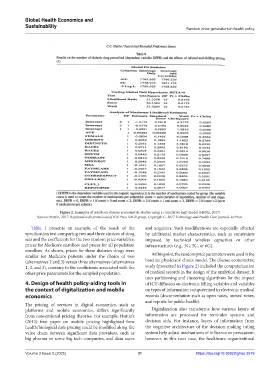
                           Figure 2. Examples of results on disease econometric studies using a cumulative logit model (Huttin, 2017)
                 Source: Huttin, 2017. Reprinted with permission of IOS Press-SAGE group, Copyright C, 2017 Technology and Health Care Journal, IosPress.

              Table  1  presents an example of the result of the   and acquirers. Such modifications are especially affected
            specification test comparing two and three choices of drug   by additional market characteristics, such as constraints
            sets and the coefficients for the two random price variables:   imposed by technical wireless capacities or other
            prices for Medicare enrollees and prices for all population   infrastructures (e.g., 3G, 5G, or 6G).
            enrollees. As shown, prices for these diabetes drugs were
            similar for  Medicare  patients  under the choice of  two   At this point, the random price parameters were used in the
            (alternatives 2 and 3) versus three alternatives (alternatives   baseline physicians’ choice model. The disease econometric
            1, 2, and 3), contrary to the coefficients associated with the   study (presented in Figure 2) included the computerization
            other price parameters for the sampled population.  of medical records in the design of the analytical dataset. It
                                                               uses partitioning and clustering algorithms for the impact
            4. Design of health policy-aiding tools in         of ICT diffusion on electronic billing variables and variables
            the context of digitalization and mobile           on types of information computerized in electronic medical
            economics                                          records (documentation such as open notes, nurses’ notes,
                                                               and reports for public health).
            The pricing of services in digital economics, such as
            platforms and mobile economics, differs significantly   Digitalization  also  transforms  how various  layers  of
            from conventional pricing theories. For example, Huttin’s   information are processed for reminder systems and
            (2012) first paper on mobile pricing highlighted how   decision aids. For instance, layers of information from
            health/biological data pricing could be modified along the   the  cognitive architecture of the decision-making ruling
            value chain between significant data providers, such as   system help adjust mechanisms of influence or persuasion;
            big pharma or some big tech companies, and data users   however, in this user case, the healthcare organizational


            Volume 3 Issue 2 (2025)                         31                       https://doi.org/10.36922/ghes.3579

