


Page 40 - GHES-3-2
P. 40
Global Health Economics and
            Sustainability
                                                                                Random price generators in health policy


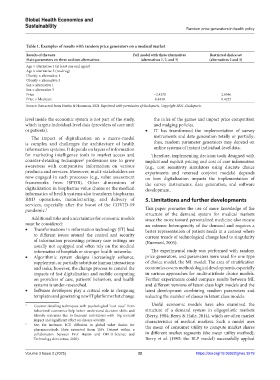
            Table 1. Examples of results with random price generators on a medical market
            Results of the tests                          Full model with three alternatives  Restricted choice set
            Main parameters on three and two alternatives    (alternatives 1, 2, and 3)   (alternatives 2 and 3)
            Age × alternative 1 (at least one oral agent)
            Age × alternative 3 (no drug)
            Obesity × alternative 1
            Obesity × alternative 3
            Sex × alternative 1
            Sex × alternative 3
            Price                                                 −2.4270                      2.8546
            Price × Medicare                                       0.4438                      0.4227
            Source: Extracted from Huttin & Hausman, 2021 Reprinted with permission of Gudapuris, Copyright 2021, Gudapuris.


            level inside the economic system is not part of the study,   the rules of the games and impact price competition
            which targets individual-level data (providers of care and/  and nudging policies.
            or patients).                                      •   IT has transformed the implementation of survey
              The  impact  of digitalization  on a  macro-model   instruments and data generation totally or partially;
            is complex and challenges the architecture of health   thus, random parameter generators may depend on
            information systems. It depends on layers of information   online systems of instant individual-level data.
            for marketing intelligence tools in market access and   Therefore, implementing decision tools designed with
            counter-detailing techniques  professions use to grow   implicit and explicit pricing and cost of care information
                                    2
            awareness with comparative information on various   (e.g., cost sensitivity simulators using discrete choice
            products and services. Moreover, multi-stakeholders are   experiments and reversed conjoint models) depends
            now engaged in such processes (e.g., value assessment   on how digitalization impacts the implementation of
            frameworks from ISPOR). Other dimensions of        the survey instruments, data generation, and software
            digitalization in biopharma value chains or the medical   development.
            informatics of health systems also transform biopharma
            R&D operations, manufacturing, and delivery of     5. Limitations and further developments
            services, especially after the boost of the COVID-19
            pandemic. 3                                        This paper promotes the use of more knowledge of the
                                                               structure of the demand system for medical markets
              Additional risks and uncertainties for economic models   since the move toward personalized medicine also means
            must be considered:                                an extreme heterogeneity of the demand and requires a
            •   Transformations in information technology (IT) lead   better representation of patient needs in a context where
               to different issues around the control and security   current trends of technological change lead to singularity
               of information processing; primary care settings are   (Kurzweil, 2005).
               usually not equipped and often rely on the medical
               informatics of hospitals or stronger health networks.  The experimental study was performed with random
            •   Algorithmic system designs increasingly enhance,   price generators, and parameters were used for one type
               supplement, or partially substitute human interactions   of choice model, the ML model. The area of stratification
               and tasks; however, the change process to control the   economics covers methodological developments, especially
               impacts of fast digitalization and mobile computing   in various approaches for multi-attribute choice models.
               on providers of care, patients’ behaviors, and health   Further experiments could compare results between ML
               systems is under-researched.                    and different versions of latent class logit models and the
            •   Software developers play a critical role in designing   latest  development  combining  random  parameters  and
               templates and generating new IT platforms that change   reducing the number of classes in latent class models.

            2    Counter detailing techniques with psychological “cost cues” from   Useful economic models have also examined the
               behavioral  economics  help  better  understand  decision  shifts  and   structure of a demand system in oligopolistic markets
               identify restraints due to  financial restrictions with  big  societal   (Berry, 1984; Berry & Haile, 2014), which are often market
               impact and significant effect on disease severity.  characteristics of medical markets.  Such a model uses
            3    See, for instance, ICT diffusion in global value chains for
               pharmaceuticals (data extracted from TiVa Dataset within a   the mean of consumer utility to compute market shares
               collaboration between Prof Huttin and OECD-Science and   in different market segments (the mean utility method);
               Technology directorate, 2020).                  Berry  et al. (1995; the BLP model) successfully applied


            Volume 3 Issue 2 (2025)                         32                       https://doi.org/10.36922/ghes.3579

