


Page 264 - GHES-3-3
P. 264
Global Health Economics and
            Sustainability
                                                                  Sustainability of Rwanda’s UHC: 2011–2021 and vision 2050


            in criticisms of the health-care system being exclusive to   monthly amount from 43.11% + 25.89% (Table S6),
            the wealthy.                                       reflecting overcharging. The monthly budget is as follows:
              Additional supply-side shortcomings that could not   (i)  Prepayment of 70%: supports health-facility
            be quantified were also identified. These include: (i)   operations and improves health-care quality. This is
            fraudulent cases at the health-post level, where utilization   divided into:
            increased by 1,645% between 2016 and 2019/2020, and (ii)   •   45% for improved functioning and quality health
            at district hospitals, fewer patients are treated, while more   care
            are referred to university teaching hospitals, with 85% of   •   10% to cover co-payments unpaid by CBHI
            district-hospital patients being sent to tertiary hospitals in   •   members
                                                                      15% for staff incentives, including support staff.
            FY 2019/2020, compared to 7% being sent to provincial   (ii)  The remaining 30%  is paid after verifying and
            hospitals. This indicates a clinical bottleneck at the
            provincial hospital level and a cost-inefficiency that risks   reconciling the invoice. This 30% comes from the 31%
            undermining the Rwandan WHO organizational system.    saved through avoided over-quantification of services
                                                                  (Table S5) and can be utilized in:
            Excessive referrals to tertiary hospitals lead to unnecessary   •   10% for disability-related medications and other
            inpatient stays and increased costs, resulting in financial   rare essential medicine shortages
            losses for CBHI.
                                                                  •   10% for patient feeding and diet services during
              Suggested solutions include (i) combating fraud at      inpatient stays
            the health post-level and addressing clientelism through   •   10% for contributing to a mandatory 20% annual
            community health workers or ghost patients, (ii)          safety margin, aiding health facilities in their
            strengthening the clinical capacity of district and provincial   goal of self-sufficiency after 5 years of FASP PPM
            hospitals, and (iii) profiling provincial hospitals based on   implementation.
            quality and quantity, with outliers potentially downgraded   Researchers ensured that the full 100% of the previous
            to district hospital status to reduce cost inefficiency.
                                                               total bill, including the 56.89% that was overpaid, is used
            3.3. Reforms and modernization of the CBHI and     effectively, as outlined above.
            public/agree (faith-based) health-care system: Best   3.3.1. Modernizing the faith-based health-care system
            practices, innovations, and alternative financing   and the partial cost-recovery system
            mechanisms (Specific Objective 3)
                                                               Modernizing the P/A health-care system and the partial
            This involves modernizing the CBHI through results-based   cost-recovery framework aims to strengthen Rwanda’s
            financing  from  a  resilience  perspective  in  the  following   CBHI and P/A health-care facilities while addressing
            way:
                                                               challenges, such as the lingering effects of the 1994 genocide,
              A business plan developed by P/A health-care facilities   the COVID-19 pandemic and global inflation, all from
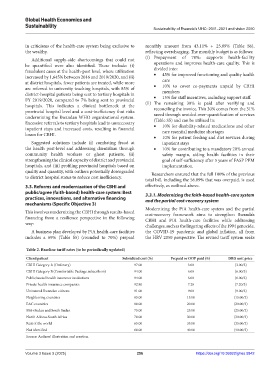
            includes a 69% (Table S5) (rounded to 70%) prepaid   the HRV 2050 perspective. The revised tariff system seeks


            Table 2. Baseline tariff rates (to be periodically updated)
            Client/patient                           Subsidized cost (%)  Prepaid or OOP paid (%)  DRG unit price
            CBHI Category A (Ordinary)                    97.00                  3.00                (3.00/3)
            CBHI Category B (Comfortable Package subscribers)  94.00             6.00                (6.00/3)
            Public/social health insurance institutions   94.00                  6.00                (6.00/3)
            Private health insurance companies            92.80                  7.20                (7.20/3)
            Uninsured Rwandan citizens                    91.00                  9.00                (9.00/3)
            Neighboring countries                         85.00                  15.00               (15.00/3)
            EAC countries                                 80.00                  20.00               (20.00/3)
            SSA+Sudan and South Sudan                     75.00                  25.00               (25.00/3)
            North Africa+South Africa                     70.00                  30.00               (30.00/3)
            Rest of the world                             65.00                  35.00               (35.00/3)
            Not identified                                60.00                  40.00               (40.00/3)
            Source: Authors’ illustration and creation.


            Volume 3 Issue 3 (2025)                        256                       https://doi.org/10.36922/ghes.5842

