


Page 261 - GHES-3-3
P. 261
Global Health Economics and
            Sustainability
                                                                  Sustainability of Rwanda’s UHC: 2011–2021 and vision 2050


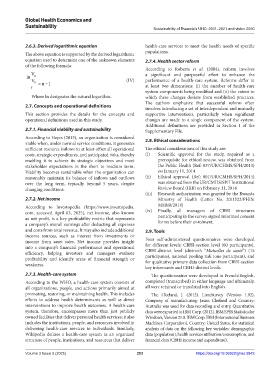
            2.6.3. Derived logarithmic equation                health-care services to meet the health needs of specific

            The above equation is supported by the derived logarithmic   populations.
            equation used to determine one of the unknown elements   2.7.4. Health sector reform
            of the following formula:
                                                               According to Roberts  et al. (2004), reform involves
              V                                                a significant and purposeful effort to enhance the
            ln  n
              V 0  =  n1−                              (IV)    performance of a health-care system. Reforms differ in
              r                                                at  least two dimensions: (i)  the  number  of  health-care
                                                               system components being modified and (ii) the extent to
              Where ln designates the natural logarithm.       which these changes deviate from established practices.
                                                               The authors emphasize that successful reform often
            2.7. Concepts and operational definitions          involves introducing a set of interdependent and mutually

            This section provides the details for the concepts and   supportive interventions, particularly when significant
            operational definitions used in this study.        changes are made to a single component of the system.
                                                               Additional definitions are provided in Section 1 of the
            2.7.1. Financial viability and sustainability      Supplementary File.
            According to Hayes (2013), an organization is considered   2.8. Ethical considerations
            viable when, under normal service conditions, it generates
            sufficient resource inflows to at least offset all operational   The ethical considerations of this study are:
            costs, strategic expenditures, and anticipated risks, thereby   (i)   Scientific approval for the study, required as a
            enabling it to achieve its strategic objectives and meet   prerequisite for ethical review, was obtained from
            stakeholder expectations in the short to medium term.   the Public Health (Ref: 037/UR/CHMS/SPH/2013)
            Viability becomes sustainable when the organization can   on January 11, 2014
            reasonably maintain its balance of inflows and outflows   (ii)   Ethical approval (Ref: 001/UR/CMHS/SPH/2014)
            over the long term, typically beyond 5  years, despite   was obtained from the UR/CMHS/SPH Institutional
            changing conditions.                                    Review Board (IRB) on February 11, 2014
                                                               (iii)  Research authorization was granted by the Rwanda
            2.7.2. Net income                                       Ministry  of  Health  (Letter  No.  20/1522/PHIS/
            According to Investopedia (https://www.investopedia.    ME&R/2014)
            com, accessed April 03, 2025), net income, also known   (iv)   Finally, all managers of CBHI structures
            as net profit, is a key profitability metric that represents   participating in the survey signed informed consent
            a company’s overall earnings after deducting all expenses   forms before their enrolment.
            and costs from total revenue. It may also include additional   2.9. Tools
            income sources, such as interest from investments or
            income  from  asset  sales.  Net  income  provides  insight   Four self-administered questionnaires were developed
            into a company’s financial performance and operational   for different levels: CBHI-section level (60 participants),
            efficiency,  helping  investors  and  managers  evaluate   CBHI-district level (district’s “Mutuelles de santé”) (15
            profitability and identify areas of financial strength or   participants), national pooling risk (one participant), and
                                                               for qualitative primary data collection from CBHI-section
            weakness.
                                                               key informants and CBHI-district levels.
            2.7.3. Health-care system                            The questionnaires were developed in French/English,
            According to the WHO, a health-care system consists of   completed (transcribed) in either language and ultimately,
            all organizations, people, and actions primarily aimed at   all were retained or translated into English.
            promoting, restoring, or maintaining health. This includes   The Cleeland, J. (2012). LimeSurvey (Version 1.92),
            efforts to address health determinants as well as direct   Company of manufacturing: Jason Cleeland and Country:
            interventions to improve health outcomes. A health-care   Australia was used for data recording and entry. Quantitative
            system, therefore, encompasses more than just publicly   data were exported to IBM Corp. (2012). IBM SPSS Statistics for
            owned facilities that deliver personal health services; it also   Windows, Version 21.0. IBM Corp. IBM (International Business
            includes the institutions, people, and resources involved in   Machines Corporation), Country: United States, for statistical
            delivering  health-care  services  to  individuals.  Similarly,   analysis of data on the following key variables: demographic
            Wikipedia defines a health-care system as an organized   data (population), health services utilization/consumption, and
            structure of people, institutions, and resources that deliver   financial data (CBHI income and expenditure).

            Volume 3 Issue 3 (2025)                        253                       https://doi.org/10.36922/ghes.5842

