


Page 15 - GPD-1-1
P. 15
Gene & Protein in Disease                                                   Bioinformatics study of PCNP


            molecular functions, ubiquitin protein ligase activity,
            small conjugating protein ligase activity, amino acid ligase
            activity, and ligase activity forming carbon nitrogen bonds
            showed  P < 0.05. The network of molecular functions
            constructed by Cytoscape software is presented in
            Figure 3B. Similarly, the cellular components results show
            the distribution of PCNP solely in the nucleus of the cell
            (Table S1). Furthermore, the pathway enrichment analysis
            was performed using the Network Analyst server. There
            were no results for the PCNP protein when searching broad
            queries on both servers (Network Analyst and Enrichr) for
            the Kyoto Encyclopedia of Genes and Genomes (KEGG)
            Reactome, and WikiPathways.
            3.5. Coexpression and PPI analysis
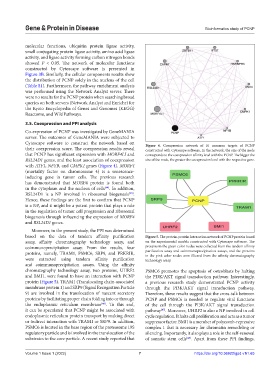
            Co-expression of PCNP was investigated by GeneMANIA
            server. The outcomes of GeneMANIA were subjected to
            Cytoscape software to construct the network based on   Figure  4. Coexpression network of 10 common targets of PCNP
            their coexpression score. The coexpression results reveal   constructed with Cytoscape software. In the network, the size of the node
            that PCNP has significant expression with MORF4LI and   corresponds to the coexpression affinity level with the PCNP. The bigger the
            RSL24D1 genes, and the least association of coexpression   size of the node, the greater the coexpression level with the respective gene.
            with ATF1, NFYB, and CMPK1 genes (Figure 4). MORF4
            (mortality factor on chromosome 4) is a senescence-
            inducing gene in tumor cells. The previous research
            has  demonstrated  that  MORF4  protein  is  found  both
            in the cytoplasm and the nucleus of cells . In addition,
                                              [44]
            RSL24D1 is a NP involved in ribosomal biogenesis .
                                                        [45]
            Hence, these findings are the first to confirm that PCNP
            is a NP, and it might be a potent protein that plays a role
            in the regulation of tumor cell progression and ribosomal
            biogenesis through influencing the expression of MORF4
            and RSL24D1 genes.
              Moreover, in the present study, the PPI was determined
            based on the data of tandem affinity purification   Figure 5. The protein-protein interaction network of PCNP protein based
            assay, affinity chromatography technology assay, and   on the experimental models constructed with Cytoscape software. The
            coimmunoprecipitation assay. From the results, four   proteins in the green color nodes were collected from the tandem affinity
            proteins, namely, TRAM1, PSMC6, SRP9, and PRKRIR,   purification assay and coimmunoprecipitation assays, and the proteins
                                                               in the pink color nodes were filtered from the affinity chromatography
            were extracted using tandem affinity purification   technology assay.
            and  coimmunoprecipitation  assays.  Using  the  affinity
            chromatography technology assay, two proteins, UHRF2   PSMC6 promotes the apoptosis of osteoblasts by halting
            and BMI1, were found to have an interaction with PCNP   the PI3K/AKT signal transduction pathway. Interestingly,
            protein (Figure 5). TRAM1 (Translocating chain-associated   a previous research study demonstrated PCNP activity
            membrane protein 1) and SRP9 (Signal Recognition Particle   through the PI3K/AKT signal transduction pathway.
            9)  are involved in  the translocation of  nascent secretory   Therefore, these results suggest that the cross-talk between
            proteins by facilitating proper chain folding into or through   PCNP and PSMC6 is needed to regulate vital functions
            the endoplasmic reticulum membrane . To this end,   of the cell through the PI3K/AKT signal transduction
                                            [46]
            it can be speculated that PCNP might be associated with   pathway . Moreover, UHRF2 is also a NP involved in cell
                                                                     [47]
            endoplasmic reticulum protein transport by making direct   cycle regulation. It halts cell proliferation and acts as a tumor
            or indirect interaction with TRAM1 or SRP9. In addition,   suppressor factor. BMI1 is a member of polycomb-repressive
            PSMC6 is located in the base region of the proteasome 19S   complex 1 that is necessary for chromatin remodeling or
            regulatory particle and is involved in the translocation of the   silencing. Importantly, it also plays a role in the self-renewal
            substrates to the core particle. A recent study reported that   of somatic stem cells . Apart from these PPI findings,
                                                                                [48]

            Volume 1 Issue 1 (2022)                         7                       https://doi.org/10.36922/gpd.v1i1.65

