


Page 59 - GPD-2-2
P. 59
Gene & Protein in Disease                                                Transfection methods for TK6 cells


                         A                                   C


                         B                                   D


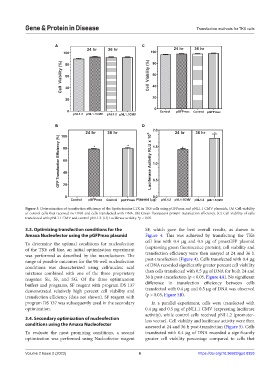
            Figure 3. Determination of transfection efficiency of the lipofectamine LTX in TK6 cells using pGFPmax and pNL1.1 CMV plasmids. (A) Cell viability
            of control cells that received no DNA and cells transfected with DNA. (B) Green fluorescent protein transfection efficiency. (C) Cell viability of cells
            transfected with pNL1.1 CMV and control pNL1.2. (D) Luciferase activity. *p < 0.05.

            3.3. Optimizing transfection conditions for the    SF,  which  gave  the  best  overall  results,  as  shown  in
            Amaxa Nucleofector using the pGFPmax plasmid       Figure  4. This was achieved by transfecting the TK6
            To determine the optimal conditions for nucleofection   cell line with 0.4  µg and 0.5  µg of pmaxGFP plasmid
            of the TK6 cell line, an initial optimization experiment   (expressing green fluorescence protein); cell viability and
            was  performed  as  described  by  the  manufacturer.  The   transfection efficiency were then assayed at 24 and 36 h
            range of possible outcomes for the 96-well nucleofection   post-transfection (Figure 4). Cells transfected with 0.4 µg
            conditions was characterized using cell/nucleic acid   of DNA recorded significantly greater percent cell viability
            mixtures combined with one of the three proprietary   than cells transfected with 0.5 µg of DNA for both 24 and
            reagents: SE, SF, and SG. Of the three optimization   36 h post-transfection (p < 0.05, Figure 4A). No significant
            buffers and programs, SF reagent with program DS 137   difference in transfection efficiency between cells
            demonstrated relatively high percent cell viability and   transfected with 0.4 µg and 0.5 µg of DNA was observed
            transfection efficiency (data not shown). SF reagent with   (p > 0.05, Figure 5B).
            program DS 137 was subsequently used in the secondary   In a parallel experiment, cells were transfected with
            optimization.                                      0.4 µg and 0.5 µg of pNL1.1 CMV (expressing luciferase
                                                               activity), while control cells received pNL1.2 (promoter-
            3.4. Secondary optimization of nucleofection       less vector). Cell viability and luciferase activity were then
            conditions using the Amaxa Nucleofector            assessed at 24 and 36 h post-transfection (Figure 5). Cells

            To evaluate the most promising conditions, a second   transfected with 0.4 µg of DNA recorded a significantly
            optimization was performed using Nucleofector reagent   greater cell viability percentage compared to cells that


            Volume 2 Issue 2 (2023)                         6                        https://doi.org/10.36922/gpd.0353

