


Page 61 - GPD-2-2
P. 61
Gene & Protein in Disease                                                Transfection methods for TK6 cells


            Table 1. The effects of different transfection methods of TK6 human lymphoblasts on transfection efficiency and cell viability
             Transfection method      Luciferase signal (RLU)    Cell viability (%)     GFP transfection efficiency (%)
            Metafectene Pro                  -                      90 – 90                     77 – 83
            Lipofectamine LTX           1.6×10 −1.8×10 5            95 – 98                     76 – 83
                                             5
            Amaxa Nucleofection         2.4×10 −8.2×10 5            80 – 85                     70 – 80
                                             5
            Abbreviations: RLU: Relative luminescence unit; GFP: Green fluorescent protein.

            A                      B                           several different cationic categories (Metafectene Pro and
                                                               Lipofectamine LTX) at delivering DNA into a TK6 human
                                                               lymphoblast.
                                                                 In our study, Metafectene Pro resulted in highly effective
                                                               transfection of plasma DNA with low toxicity into TK6
                                                               human lymphoblasts resulting in high percent cell viability
                                                               and transfection efficiency. However, no luciferase activity
                                                               was detected in TK6  cells transfected with Metafectene.
                       C                                       The absence of luciferase activity when transfected with
                                                               Metafectene Pro suggests that the presence of certain
                                                               chemotypes in Metafectene inhibits or interferes with
                                                               NanoLuciferase luciferase activity in Nano-Glo Luciferase.
                                                               Some inhibitors of NanoLuc include those with a phenyl-
                                                               1,4-dihydropyridine  found in  the  drug  isradipine  and
                                                                             [53]
                                                               aryl  sulfonamide .  Interestingly,  studies  showed  that
                                                               luciferase activities were detected when the same cells were
                                                                                       [54]
                                                               cotransfection with GFP-Max . Furthermore, luciferase
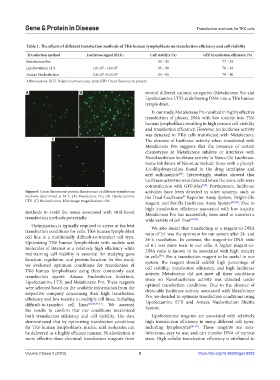
            Figure 6. Green fluorescent protein fluorescence of different transfection   activities  have  been  detected in other  systems,  such  as
            methods determined at 24 h. (A) Metafectene Pro, (B) Lipofectatmine   the Dual-Luciferase  Reporter Assay System, Bright-Glo
                                                                               ®
            LTX. (C) Nucleofection. Microscope magnification: ×20.                                 [55,56]
                                                               reagent, and Renilla Luciferase Assay System  . Due to
                                                               high transfection efficiency associated with low toxicity,
            methods to avoid the issues associated with viral-based   Metafectene Pro has successfully been used to transfect a
            transfection methods potentially.                  wide variety of cell lines [57,58] .
              Optimization is typically required to arrive at the best   We also found that transfecting at a reagent-to-DNA
            transfection conditions for cells. TK6 human lymphoblast   ratio of 3:1 was the optimum for our system after 24- and
            cell line is a traditionally difficult-to-transfect cell type.   36-h incubation. In contrast, the reagent-to-DNA ratio
            Optimizing TK6 human lymphoblasts with nucleic acid   of  6:1 was  more  toxic  to  our cells.  A  higher  reagent-to-
            molecules of interest at a relatively high efficiency while   DNA ratio is known to be associated with high toxicity
            maintaining cell viability is essential for studying gene   in cells . For a transfection reagent to be useful in our
                                                                     [59]
            function, regulation, and protein function. In this study,   system, the reagent should exhibit high percentage of
            we evaluated optimum conditions for transfection of   cell viability, transfection efficiency, and high luciferase
            TK6  human lymphoblasts  using  three  commonly  used   activity. Metafectene did not meet all these conditions
            transfection agents: Amaxa Nucleofector Solutions,   since  no NanoLuciferase  activity  was detected  under
            Lipofectamine LTX, and Metafectene Pro. These reagents   optimal transfection conditions. Due to the absence of
            were selected based on the available information from the   detectable luciferase activity associated with Metafectene
            respective company concerning their high transfection   Pro, we decided to optimize transfection conditions using
            efficiency and low toxicity in multiple cell lines, including   Lipofectamine LTX and Amaxa Nucleofection Shuttle
            difficult-to-transfect cell lines [20,28,49-52] . We assessed   System.
            the results to confirm that our conditions maximized
            both transfection efficiency and cell viability. The data   Lipofectamine reagents are associated with relatively
            demonstrated that by optimizing transfection conditions   high transfection efficiency in many different cell types,
            for TK6 human lymphoblasts, nucleic acid molecules can   including lymphocytes [60-62] . These reagents are non-
            be delivered in a highly efficient manner. Nucleofection is   infectious, easy to use, and can transfer DNA of various
            more effective than chemical transfection reagents from   sizes. High cellular transfection efficiency is attributed to


            Volume 2 Issue 2 (2023)                         8                        https://doi.org/10.36922/gpd.0353

