


Page 57 - GPD-2-2
P. 57
Gene & Protein in Disease                                                Transfection methods for TK6 cells


            in a humidified 37°C/5% CO  atmosphere. Transfection   3. Results
                                    2
            efficiency using GFP  was determined by  fluorescence
            microscopy and by assaying for normalized luciferase   3.1. Optimizing transfection conditions for
            activity. Cell viability was determined using the Vi-CELL   Metafectene Pro transfection reagent
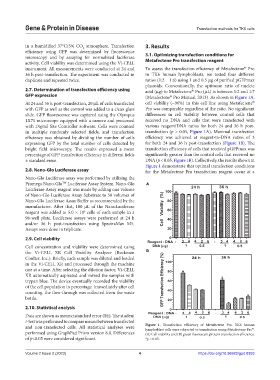
            instrument. All measurements were conducted at 24 and   To assess the transfection efficiency of Metafectene  Pro
                                                                                                         ®
            36 h post-transfection. The experiment was conducted in   in TK6 human lymphoblasts, we tested four different
            duplicate and repeated twice.                      ratios (1:2 – 1:6) using 1 and 0.5 µg of purified pGFPmax
                                                               plasmids. Conventionally, the optimum ratio of nucleic
            2.7. Determination of transfection efficiency using   acid (µg) to Metafectene  Pro (µL) is between 1:2 and 1:7
                                                                                   ®
            GFP expression                                     (Metafectene  Pro Manual, 2013). As shown in Figure 1A,
                                                                         ®
            At 24 and 36 h post-transfection, 20 µL of cells transfected   cell viability (~96%) in this cell line using Metafectene
                                                                                                            ®
            with GFP as well as the control was added to a clean glass   Pro was comparable regardless of the ratio. No significant
            slide. GFP fluorescence was captured using the Olympus   differences  in  cell  viability  between  control  cells  that
            1X71 microscope equipped with a camera and processed   received no DNA and cells that were transfected with
            with Digital Site Controller software. Cells were counted   various reagent/DNA ratios for both 24 and 36  h post-
            in multiple randomly selected fields, and transfection   transfection (p > 0.05, Figure 1A). Maximal transfection
            efficiency was obtained by dividing the number of cells   efficiency was achieved at reagent-to-DNA ratios of 3
            expressing GFP by the total number of cells detected by   for both 24 and 36 h post-transfection (Figure 1B). The
            bright  field  microscopy.  The  results  expressed  a  mean   transfection efficiency of cells that received pGFPmax was
            percentage of GFP transfection efficiency in different fields   significantly greater than the control cells that received no
            ± standard error.                                  DNA (p < 0.05, Figure 1B). Collectively, the results shown in
                                                               Figure 1 demonstrate that optimal transfection conditions
            2.8. Nano-Glo Luciferase assay                     for  the Metafectene  Pro transfection  reagent  occur  at  a
            Nano-Glo Luciferase assay was performed by utilizing the
            Promega Nano-Glo  Luciferase Assay System. Nano-Glo   A
                            TM
            Luciferase Assay reagent was made by adding one volume
            of Nano-Glo Luciferase Assay Substrate to 50 volumes of
            Nano-Glo Luciferase Assay Buffer as recommended by the
            manufacturer. After that, 100  µL of the NanoLuciferase
            reagent was added to 5.0 × 10  cells of each sample in a
                                     5
            96-well plate. Luciferase assays were performed at 24  h
            and/or  36  h post-transfection using SpectraMax  M5.
            Assays were done in triplicate.

            2.9. Cell viability
            Cell concentration and viability were determined using
            the Vi-CELL XR Cell Viability Analyzer (Beckman    B
            Coulter, Inc.). Briefly, each sample was diluted and loaded
            in the Vi-CELL XR and processed through the machine
            one at a time. After selecting the dilution factor, Vi-CELL
            XR automatically aspirated and mixed the samples with
            trypan blue. The device eventually recorded the viability
            of the cell population in percentage. Immediately after cell
            counting, the flow-through was collected from the waste
            bottle.

            2.10. Statistical analysis
            Data are shown as means±standard error (SE). The student
            t-test was performed to compare means between transfected
            and non-transfected cells. All statistical analyses were   Figure  1.  Transfection efficiency  of  Metafectene Pro.  TK6 human
                                                                                                            ®
                                                               lymphoblast cells were subjected to transfection using Metafectene Pro .
            performed using GraphPad Prism version 8.0. Differences   (A) Cell viability and (B) green fluorescent protein transfection efficiency.
            of p<0.05 were considered significant.             *p < 0.05.

            Volume 2 Issue 2 (2023)                         4                        https://doi.org/10.36922/gpd.0353

