


Page 60 - GTM-2-2
P. 60
Global Translational Medicine                                     New insights into chronic pain management


            pathology or distraction. They are the key mechanisms   statistically more often in patients with nociceptive pain
            that  alter  the  proper  functioning  of  the  descending   in 82% (Figure  7). Chronic pain is always accompanied
            noradrenergic and serotoninergic system . Dysfunction   by emotional disorders and insomnia. When  the pain
                                             [48]
            of the descending noradrenergic and serotoninergic system   transforms into chronic pain, a psychological component
            is predominant and determines mechanism-oriented   comes to the forefront in supporting pain behavior and
            treatment . That explains why patients with chronic pain   suffering. These results can be explained by the activation
                    [48]
            experienced low efficacy of NSAIDs or anticonvulsants.   of nociceptive neurons and certain supraspinal structures,
            Antinociceptive activity is regulated by only 5HT1A and   such as anterior cingulate cortex, right dorsolateral
            5HT2 serotonin receptors, but 5HT3 serotonin receptors   prefrontal cortex, left middle frontal gyrus, and left lateral
            do not participate in pain control system . Management   occipital cortex, as well as PAG region and basal main
                                             [49]
            of chronic pain, accompanied by depression, should   functions, that are revealed during functional magnetic
            include antidepressants that target depression mechanisms   resonance imaging. The main functions of these structures
            (the main factor of pain chronicity) and chronic pain   are to regulate cognition, emotional processes, and
            mechanisms. Vortioxetine is an antidepressant with   behavior.  These  interactions  provide  inseparable  affinity
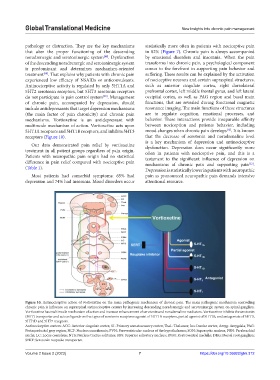
            multimode mechanism of action. Vortioxetine acts upon   between nociception and patients behavior, including
                                                                                                 [12]
            5HT1A receptors and 5HT1B receptors, and inhibits 5HT3   mood changes when chronic pain develops . It is known
            receptors (Figure 10).                             that the decrease of serotonin and noradrenaline level
                                                               is a key mechanism of depression and antinociceptive
              Our  data  demonstrated  pain  relief  by vortioxetine
            treatment in all patient groups regardless of pain origin.   dysfunction. Depression does occur significantly more
                                                               often in  patients  with nociceptive pain,  and this is  a
            Patients with neuropathic pain origin had no statistical   testament  to  the  significant  influence  of  depression  on
            difference in pain relief compared with nociceptive pain   mechanisms of  chronic pain  and supporting  pain .
                                                                                                           [12]
            (Table 1).                                         Depression is statistically lower in patients with neuropathic
              Most patients had comorbid symptoms: 65% had     pain as pronounced neuropathic pain demands intensive
            depression and 74% had insomnia. Mood disorders occur   attentional resource.


            Figure 10. Antinociceptive action of vortioxetine on the main pathogenic mechanism of chronic pain. The main pathogenic mechanism controlling
            chronic pain is influence on supraspinal antinociceptive centers by increasing descending noradrenergic and serotoninergic system on spinal ganglion.
            Vortioxetine has multimode mechanism of action and increase enhancement of serotonin and noradrenaline mediators. Vortioxetine inhibits the serotonin
            (5HT) transporter and acts as ligands on five types of serotonin receptors: agonist of 5HT1A receptors, partial agonist of 5HT1B, and antagonists of 5HT3,
            5HT1D and 5HT7 receptors.
            Antinociceptive centers: ACC: Anterior cingulate cortex; S1: Primory somatosensory cortex; Thal.: Thalamus; Ins: Insular cortex; Amyg: Amygdala; PAG:
            Periaqueductal gray region; NCF: Nucleus cuneiformis; PVN: Paraventricular nucleus of the hypothalamus; SON: Supraoptic nucleus; PBN: Parabrachial
            nuclei; LC: Locus coeruleus; NTS: Nucleus tractus solitaries; SSN: Superior salivatory nucleus; RVM: Rostroventral medulla; DRG: Dorsal rout ganglion;
            SERT: Serotonin reuptake transporter.

            Volume 2 Issue 2 (2023)                         7                         https://doi.org/10.36922/gtm.312

