


Page 55 - GTM-2-2
P. 55
Global Translational Medicine                                     New insights into chronic pain management


            Chronic pain develops after an injury or a disease, loses
            signal value, and begins to exist according to its own
            rights without accompanying symptoms of other diseases.
            Chronic pain is maladaptive and has no beneficial
            biological significance and is characterized by spontaneous
            pain as well as evoked pain in response to noxious or non-
            noxious stimuli [3-5] .
              Chronic  pain  differs  in  terms  of  their  biology,
            pathogenesis, clinic, treatment, and prognosis [6,7] . The
            pathogenesis of chronic pain includes interactions between
            sensory, autonomic, motor, emotional, and cognitive
            spheres. Key mechanisms of pain consist of neuronal
            plasticity and peripheral sensitization in primary sensory
            neurons of dorsal root ganglia and trigeminal ganglia [8-10]
            and central sensitization in pain processing neurons of
            the spinal cord and brain [11-13] . The core of the pathogenic
            mechanism of pain is functional changes in the central
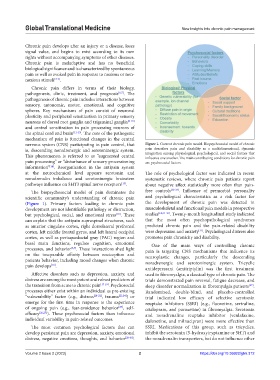
            nervous system (CNS) participating in pain control, that   Figure 1. Current chronic pain model. Biopsychosocial model of chronic
            is,  descending  noradrenergic  and  serotoninergic  system.   pain describes pain and disability as a multidimensional, dynamic
                                                               integration among physiological, psychological, and social factors that
            This phenomenon is referred to as “augmented central   influence one another. The main contributing conditions for chronic pain
            pain processing” or “disturbance of sensory processioning   are psychosocial factors.
            information” . Reorganization in the antipain system
                      [14]
            at the neurochemical level appears serotonin and   The role of psychological factor was indicated in recent
            noradrenalin imbalance and serotoninergic brainstem   systematic reviews, where chronic pain patients report
            pathways influence on 5НТ3 spinal nerve receptors .  about negative affect statistically more often than pain-
                                                     [15]
              The  biopsychosocial model of  pain  dominates  the   free controls [30-32] . Influence of premorbid personality
            scientific community’s understanding of chronic pain   and psychological characteristics as a risk factor for
            (Figure  1). Primary factors leading to chronic pain   the development of chronic pain was detected in
            development are not identifiable pathology or distraction,   musculoskeletal and functional pain models in prospective
            but psychological, social, and emotional stress . These   studies [18,33-36] . Twenty-month longitudinal study indicated
                                                  [16]
            can explain that the antipain supraspinal structures, such   that the most often psychopathological syndromes
            as anterior cingulate cortex, right dorsolateral prefrontal   predicted chronic pain and the pain-related disability
            cortex, left middle frontal gyrus, and left lateral occipital   were depression and anxiety . Psychological distress also
                                                                                     [21]
            cortex, as well as periaqueductal gray (PAG) region and   promotes pain chronicity and disability.
            basal main functions, regulate cognition, emotional   One of the main ways of controlling chronic
            processes, and behavior [6,7] . These interactions shed light   pain is targeting CNS mechanisms that influence its
            on the inseparable affinity between nociception and   neuroplastic changes, particularly the descending
            patients behavior, including mood changes when chronic   noradrenergic and serotoninergic system. Tricyclic
            pain develops .
                       [16]
                                                               antidepressant (amitriptylin) was the first treatment
              Affective disorders such as depression, anxiety, and   used in fibromyalgia, a classical type of chronic pain. The
            distress are among the most potent and robust predictors of   trials demonstrated pain reversal, fatigue decrease, and
            the transition from acute to chronic pain [17-19] . Psychosocial   sleep disorder normalization in fibromyalgia patients [37] .
            processes either exist within an individual as pre-existing   Randomized, double-blind, and placebo-controlled
            “vulnerability” factor (e.g., distress [20-22] , trauma [23,24] ) or   trial indicated low efficacy of selective serotonin
            emerge for the first time in response to the experience   reuptake inhibitors (SSRI) (e.g., fluoxetine, sertraline,
            of ongoing pain (e.g., fear-avoidance behavior , self-  citalopram, and paroxetine) in fibromyalgia. Serotonin
                                                   [25]
            efficacy [26,27] ). These psychosocial factors then influence   and noradrenaline reuptake inhibitor (venlafaxine,
            individual variability in pain-related outcomes.   duloxetine, and milnacipran) were more effective than
              The  most common psychological factors that  can   SSRI.  Medications  of  this  group,  such  as  tricyclics,
            develop persistent pain are depression, anxiety, emotional   inhibit the serotonin (5-hydroxytryptamine or 5HT) and
            distress, negative emotions, thoughts, and behavior [28-30] .   the noradrenalin transporters, but do not influence other


            Volume 2 Issue 2 (2023)                         2                         https://doi.org/10.36922/gtm.312

