


Page 51 - GTM-2-2
P. 51
Global Translational Medicine                                                    FTO gene and obesity


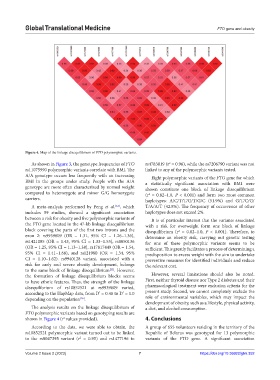
            Figure 4. Map of the linkage disequilibrium of FTO polymorphic variants.

              As shown in Figure 3, the genotype frequencies of FTO   rs4783819 (r  = 0.96), while the rs7206790 variant was not
                                                                         2
            rs11075990 polymorphic variants correlate with BMI. The   linked to any of the polymorphic variants tested.
            A/A genotype occurs less frequently with an increasing   Eight polymorphic variants of the FTO gene for which
            BMI in the groups under study. People with the A/A   a statistically significant association with BMI were
            genotype are more often characterized by normal weight   shown constitute one block of linkage disequilibrium
            compared to heterozygote and minor G/G homozygote   (r  = 0.82–1.0,  P  < 0.001) and form two most common
                                                                2
            carriers.                                          haplotypes: A/C/T/T/G/T/G/C (51.9%) and G/T/C/G/
              A meta-analysis performed by Peng et al. , which   T/A/A/T (42.8%). The frequency of occurrence of other
                                                  [12]
            includes 59 studies, showed a significant association   haplotypes does not exceed 2%.
            between a risk for obesity and five polymorphic variants of   It is of particular interest that the variants associated
            the FTO gene located in the 47-kb linkage disequilibrium   with a risk for overweight form one block of linkage
            block covering the parts of the first two introns and the   disequilibrium (r  = 0.82–1.0,  P  < 0.001). Therefore, to
                                                                             2
            exon 2: rs9939609 (OR = 1.31, 95% CI = 1.26–1.36),   determine an obesity risk, carrying out genetic testing
            rs1421085 (OR = 1.43, 95% CI = 1.33–1.53), rs8050136   for  one of  these polymorphic  variants  seems  to  be
            (OR = 1.25, 95% CI = 1.13–1.38), rs17817449 (OR = 1.54,   sufficient. This greatly facilitates a process of determining a
            95% CI  =  1.41–1.68),  and rs121980  (OR  = 1.34,  95%   predisposition to excess weight with the aim to undertake
            CI  =  1.10–1.62). rs9940128 variant, associated with a   preventive measures for identified individuals and reduce
            risk  for  early  and  severe  obesity  development,  belongs   the relevant cost.
            to the same block of linkage disequilibrium . However,
                                                [25]
            the formation of linkage disequilibrium blocks seems   However, several limitations should also be noted.
            to have ethnic features. Thus, the strength of the linkage   First, neither thyroid disease nor Type 2 diabetes and their
            disequilibrium of rs10852521 at rs9939609 varied,   pharmacological treatment were exclusion criteria for the
            according to the HapMap data, from D’ = 0.48 to D’ = 1.0   present study. Second, we cannot completely exclude the
            depending on the population .                      role of environmental variables, which may impact the
                                   [26]
                                                               development of obesity, such as a lifestyle, physical activity,
              The analysis results on the linkage disequilibrium of   a diet, and alcohol consumption.
            FTO polymorphic variants based on genotyping results are
            shown in Figure 4 (r  values provided).            4. Conclusions
                            2
              According  to  the  data,  we  were  able  to  obtain,  the   A group of 655 volunteers residing in the territory of the
            rs10852521 polymorphic variant turned out to be linked   Republic of Belarus was genotyped for 13 polymorphic
            to the rs8047395 variant (r  = 0.95) and rs1477196 to   variants of the  FTO gene. A  significant association
                                   2

            Volume 2 Issue 2 (2023)                         7                         https://doi.org/10.36922/gtm.352

