


Page 17 - GTM-3-3
P. 17
Global Translational Medicine                                   Influence of estrogen on RV mitochondria in PH


            6.3. NRF1/2                                        E2 and its role in regulating RV mitochondrial function in

            To date, two members of the NRF family have been   PAH are required.
            identified: NRF1 and several isoforms of NRF2, also   6.5. ERK1/2 (MAPK)
            known as GA-binding protein (GABPA). The NRF family
            has been shown to be activated by PGC-1α and once   When E2 binds to the plasma membrane GPER (also
                                                                                                           94,95
            activated, targets several genes related to mitochondria and   known as GPR30), it activates Gα, Gβ, and Gγ subunits,
            respiration. 89,90   Once  activated, for  instance  by  PGC-1α,   which then stimulates cAMP and cyclic guanosine
                                                                                              95
            NRF1 and NRF2 will then bind to three key mitochondrial   monophosphate (cGMP) production.  The production
            transcription factors, TFAM, mitochondrial transcription   of cAMP and cGMP activates several signaling pathways
            factor  B1  (TFB1M),  and  mitochondrial  transcription   including the indirect activation of calcium. 94-96  The
                                                                           2+
            factor B2 (TFB2M) to promote upregulation of their   intracellular Ca  release is thought to be one of the main
                                                                                                            68
            expression.  These three transcription factors can then   mechanisms by which GPER influences the mitochondria.
                     90
            be translocated to the mitochondria to induce  mtDNA   In addition, the major kinase enzyme family activated
            replication, transcription, and hence, biogenesis. Mutation   through the GPER, MAPK, and one of its subfamilies
            in the NRF1 binding site has been shown to completely   ERK1/2 play a key role in regulating proliferation in
                                                                                                       97
            abolish the activation of TFAM, with mutations in the   response to oxidants, hormones, and stress factors,  hence
            NRF2 binding site shown to only dampen TFAM activity. 91  influencing mitochondrial function in PAH. 98
              The role of the NRF family is just beginning to be   Although the data on ERK1/2 in RV in PAH is limited,
            understood in PAH. One study illustrated that  NRF1   there are few studies on the lungs in PAH. ERK1/2 levels are
            mRNA expression showed no changes in the RV of male   significantly elevated in the lungs of human PAH patients
                                                                                                            97
            MCT rats.  Another study found an increased NRF1 in the   (40% male and 60% female) and in hypoxic male rats.
                    85
            RV of male rats following 14 days in hypoxia.  Since chronic   There is also an increase in ERK1/2 phosphorylation in the
                                              92
            hypoxia alone only results in an adaptive or compensated   pulmonary arteries of male MCT rats. 28,99  An increase in
            RV, the reason for this increased NRF1 in hypoxic rats   ERK1/1 was found to stimulate dynamin-related protein
            could be due to positive feedback in the RV to prevent RV   1 (DRP1), resulting in excess mitochondrial fission and
                                                                                                    99
            failure as the NRFs mediate protective effects. Given the   proliferation in PASMCs of male MCT rats.  An ERK
            potential role of the NRF family in mitochondrial function
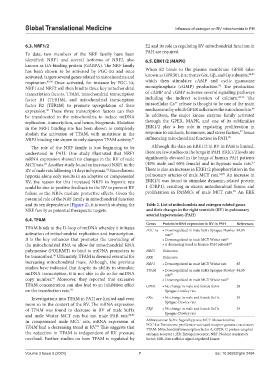
            and its sex dependence (Figure 2), it is worth studying the   Table 2. List of mitochondria and estrogen‑related genes
            NRF family as potential therapeutic targets.       and their changes in the right ventricle (RV) in pulmonary
                                                               arterial hypertension (PAH)
            6.4. TFAM
                                                               Genes  Protein/mRNA expression in RV in PAH  References
            TFAM binds to the D-loop of mtDNA whereby it initiates   PGC‑1α  •  Downregulated in male SuHx Sprague‑Dawley  84,85
            activation of mitochondrial replication and transcription.   rats 84
            It is the key enhancer that promotes the unwinding of     • Downregulated in male MCT Wistar rats 85
            the mitochondrial RNA to allow for mitochondrial RNA      • A decreasing trend in human PAH patients 84
            polymerase (POLRMT) to bind to mtDNA promoters to   NRF2  Unknown
            be transcribed.  Ultimately, TFAM is deemed essential for   ERK  Unknown
                        90
            increasing mitochondrial mass. Although, the previous   NRF1  • Downregulated in male MCT Wistar rats   85
            studies have indicated that despite its ability to stimulate   TFAM  •  Downregulated in male SuHx Sprague‑Dawley  84,85
            mtDNA transcription, it is not able to do so for mtDNA     rats 84
            copy number.  Moreover, they reported that excessive      • Downregulated in male MCT Wistar rats 85
                       93
            TFAM concentration can also lead to an inhibition effect   GPER  •  No change in male and female SuHx   29
            on the transfection rate. 93                               Sprague-Dawley rats
              Investigations into TFAM in PAH are limited and even   ERα  •  No change in male and female SuHx   29
            more so in the context of the RV. The mRNA expression      Sprague-Dawley rats
            of  TFAM was found to decrease in RV of male SuHx   ERβ   •  No change in male and female SuHx   29
            and male Wistar MCT rats but not male PAB rats. 84,85      Sprague-Dawley rats
            In compensated male MCT rats, mRNA expression of   Abbreviations: SuHx: Sugen/hypoxia; MCT: Monocrotaline;
            TFAM had a decreasing trend in RV.  This suggests that   PGC-1α: Peroxisome proliferator-activated receptor gamma coactivator;
                                          85
                                                               TFAM: Mitochondrial transcription factor A; GPER: G protein-coupled
            the  reduction in  TFAM  is  independent  of  RV pressure   estrogen receptor 1; ER: Estrogen receptor; NRF: Nuclear respiratory
            overload. Further studies on how TFAM is regulated by   factor; ERK: Extracellular signal-regulated kinase.

            Volume 3 Issue 3 (2024)                         7                               doi: 10.36922/gtm.2494

