


Page 68 - GTM-3-3
P. 68
Global Translational Medicine                                  Evidence-based approach for TCM development


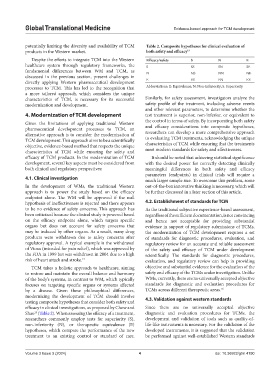
            potentially limiting the diversity and availability of TCM   Table 2. Composite hypotheses for clinical evaluation of
            products in the Western market.                    both safety and efficacy 15
              Despite the efforts to integrate TCM into the Western   Efficacy/safety  S      N           E
            healthcare system through regulatory frameworks, the   S              SS          SN          SE
            fundamental differences between WM and TCM, as     N                  NS          NN          NE
            discussed in the previous section, present challenges in
            directly applying Western pharmaceutical development   E              ES          EN          EE
            processes to TCM. This has led to the recognition that   Abbreviations: E: Equivalence; N: Non-inferiority; S: Superiority.
            a more tailored approach, which considers the unique
            characteristics of TCM, is necessary for its successful   Similarly, for safety assessment, investigators analyze the
            modernization and development.                     safety profile of the treatment, including adverse events
                                                               and other relevant parameters, to determine whether the
            4. Modernization of TCM development                test treatment is superior, non-inferior, or equivalent to
                                                               the control in terms of safety. By incorporating both safety
            Given the limitations of applying traditional Western
            pharmaceutical development processes to TCM, an    and efficacy considerations into composite hypotheses,
            alternative approach is to consider the modernization of   researchers can develop a more comprehensive approach
                                                               to evaluating TCM treatments, acknowledging the unique
            TCM development. This approach aims to be a scientifically
            objective, evidence-based method that respects the unique   characteristics of TCM while ensuring that the treatments
            characteristics of TCM while ensuring the safety and   meet modern standards for safety and effectiveness.
            efficacy of TCM products. In the modernization of TCM   It should be noted that achieving statistical significance
            development, several key aspects must be considered from   with the desired power for correctly detecting clinically
            both clinical and regulatory perspectives:         meaningful differences in both safety and efficacy
                                                               parameters (endpoints) in clinical trials will require a
            4.1. Clinical investigation                        much larger sample size. To overcome this problem, some
            In the development of WMs,  the traditional Western   out-of-the-box innovative thinking is necessary, which will
            approach  is  to  power  the  study  based  on  the  efficacy   be further discussed in a later section of this article.
            endpoint alone. The WM will be approved if the null
            hypothesis of ineffectiveness is rejected and there appears   4.2. Establishment of standards for TCM
            to be no evidence of safety concerns. This approach has   As the traditional subjective experience-based assessment,
            been criticized because the clinical study is powered based   regardless of the sufficient documentation, is not convincing
            on the efficacy endpoint alone, which targets specific   and hence not acceptable for providing substantial
            organs  but  does  not  account  for  safety  concerns  that   evidence in support of regulatory submissions of TCMs,
            may be induced by other organs. As a result, many drug   the  modernization  of  TCM  development  requires  a  set
            products were withdrawn due to safety concerns after   of standards for diagnostic procedures, evaluation, and
            regulatory approval. A typical example is the withdrawal   regulatory review for an accurate and reliable assessment
            of Vioxx (intended for pain relief), which was approved by   of the safety and efficacy of TCM under development
            the FDA in 1999 but was withdrawn in 2004 due to a high   scientifically. The standards for diagnostic procedures,
            risk of heart attack and stroke. 14                evaluation, and regulatory review can help in providing
              TCM takes a holistic approach to healthcare, aiming   objective and substantial evidence for the evaluation of the
            to restore and maintain the overall balance and harmony   safety and efficacy of the TCMs under investigation. Unlike
            of the body’s systems, in contrast to WM, which typically   WMs, currently, there are no universally accepted objective
            focuses on targeting specific organs or systems affected   standards for diagnostic and evaluation procedures for
            by a disease. Given these philosophical differences,   TCMs across different therapeutic areas. 16
            modernizing the development of TCM should involve   4.3. Validation against western standards
            testing composite hypotheses that consider both safety and
            efficacy in clinical investigations, as proposed by Chow and   Since there are no universally accepted objective
            Shao  (Table 2). When assessing the efficacy of a treatment,   diagnostic and evaluation procedures for TCMs, the
                15
            researchers commonly employ tests for superiority (S),   development and validation of tools such as quality-of-
            non-inferiority (N), or therapeutic equivalence (E)   life-like instruments is necessary. For the validation of the
            hypotheses, which compare the performance of the new   developed instruments, it is suggested that the validation
            treatment to an existing control or standard of care.   be performed against well-established Western standards


            Volume 3 Issue 3 (2024)                         4                               doi: 10.36922/gtm.4190

