


Page 69 - GTM-3-3
P. 69
Global Translational Medicine                                  Evidence-based approach for TCM development


            such as clinical, surrogate, or biomarker endpoints in terms   5. Innovative thinking on the
            of sensitivity and specificity of the developed instruments.   modernization of TCM development
            The validated instrument should be able to inform the
            disease status and/or treatment effect at various stages or   In the pursuit of modernizing TCM development,
            phases of clinical development/investigation.      several innovative approaches from other fields can be
                                                               adapted to enhance TCM clinical trials. These approaches
            4.4. Examples of current TCM modernization efforts  include: (i) demonstrating “not unsafe” for safety and “not
            Recent efforts to modernize TCM have resulted in   ineffectiveness” for efficacy; (ii) using composite hypotheses
            significant advancements that bridge traditional practices   to evaluate both safety and efficacy simultaneously; and
            with modern scientific approaches. One notable example is   (iii) incorporating RWD and RWE to support regulatory
            the clinical research on carotid artery plaque intervention   approval. These innovative approaches will be briefly
            with the Tongxinluo capsule. This multicenter,     described below.
            randomized, double-blind, placebo-controlled study,   5.1. The concept of demonstrating not unsafe and
            led by Zhang  et al.,  involved 1212  patients with   not ineffectiveness
                               17
            carotid atherosclerotic plaque. The study demonstrated
            that Tongxinluo therapy, when added to conventional   The concept of demonstrating “not unsafe” and “not
            treatment, could slow the progression of carotid intima-  ineffectiveness” differs from the conventional approach
            media thickness, plaque area, and vascular remodeling   of demonstrating “safe” and “effective.” In this approach,
            index, while also reducing cardiovascular events with a   the  null  hypothesis  of  ineffectiveness  is  tested  against
            strong safety profile.                             the alternative hypothesis of “not ineffectiveness” rather
                                                               than “effectiveness”.  Rejecting the null hypothesis in
                                                                               21
              Another example is the global success of artemisinin, a   favor  of  “not  ineffectiveness”  does  not  necessarily  imply
            compound derived from the TCM herb Artemisia annua.    effectiveness. This approach can be particularly useful in
                                                         18
            Discovered by Tu Youyou, artemisinin has become a first-  TCM development as well as in the development of drugs
            line treatment for malaria, endorsed by the WHO. Its   for rare diseases. 21
            widespread use has contributed significantly to malaria   In practice, researchers typically test the null hypothesis
            control,  including  near  eradication  in  regions  such  as   at the α = 5% level of significance, although some prefer
            the Comoros Islands, and earned Tu the Nobel Prize in   testing at the  α = 1% level. If the observed  P-value
            Physiology or Medicine in 2015. 19
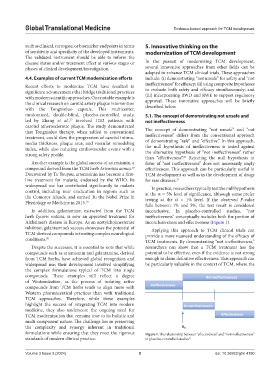
                                                               falls between 1% and 5%, the test result is considered
              In addition, galantamine, extracted from the TCM   inconclusive.  In  placebo-controlled  studies,  “not
            herb  Lycoris radiata, is now an approved treatment for   ineffectiveness” conceptually includes both the portion of
            Alzheimer’s disease in Europe. As an acetylcholinesterase   inconclusiveness and effectiveness (Figure 1).
            inhibitor, galantamine’s success showcases the potential of   Applying this approach to TCM clinical trials can
            TCM-derived compounds in treating complex neurological   provide a more nuanced understanding of the efficacy of
            conditions. 20                                     TCM treatments. By demonstrating “not ineffectiveness,”
              Despite the successes, it is essential to note that while   researchers can show that a TCM treatment has the
            compounds such as artemisinin and galantamine, derived   potential to be effective, even if the evidence is not strong
            from TCM herbs, have achieved global recognition and   enough to claim definitive effectiveness. This approach can
            widespread use; their development involved simplifying   be particularly valuable in the context of TCM, where the
            the complex formulations typical of TCM into single
            compounds.  These  examples  still  reflect  a degree
            of Westernization, as the process of isolating active
            compounds  from  TCM  herbs  tends  to  align  more  with
            Western pharmaceutical practices than with traditional
            TCM approaches. Therefore, while these examples
            highlight the success of integrating TCM into modern
            medicine, they also underscore the ongoing need for
            TCM modernization that remains true to its holistic and
            multi-component nature. The challenge lies in preserving
            the complexity and synergy inherent in traditional
            formulations while ensuring that they meet the rigorous   Figure 1. The relationship between “effectiveness” and “not ineffectiveness”
            standards of modern clinical practice.             in placebo-controlled studies 21


            Volume 3 Issue 3 (2024)                         5                               doi: 10.36922/gtm.4190

