


Page 76 - GTM-3-3
P. 76
Global Translational Medicine                               Graphene oxide in cancer drug delivery applications


            based materials are distinguished by their exceptional   control to prevent the formation of explosive by-products,
            physicochemical properties, including high surface   followed by extensive washing to remove residual acids
            area, biocompatibility, and versatile functionalization   and impurities.  Brodie’s method yields a greater relative
                                                                           12
            capabilities.  Such properties make GO and rGO highly   quantity of hydroxyl groups and achieves a more uniform
                     7,8
            suitable for drug delivery and theranostics, an integrated   distribution of functional groups across the planar surface
            method  that  combines  therapy  and  diagnostics  to  offer   of GO flakes.  However, despite its historical significance,
                                                                         13
            more individualized cancer treatment. 9            Brodie’s method has limitations, including the use of
              The capacity of GO and rGO to efficiently transport and   hazardous chemicals and the generation of toxic gases,
            administer concentrated therapeutic substances directly to   which pose significant safety and environmental concerns.
            tumor sites, coupled with their adjustable surface chemistry   2.2. Staudenmaier’s method
            for controlled drug release, represents noteworthy progress
            in the field of cancer treatment.  Moreover, the distinctive   Staudenmaier’s  method is  a  modification of  Brodie’s
                                     10
            optical qualities of GO make it well-suited for applications   method, wherein graphite is oxidized using a mixture of
            in photothermal and photodynamic therapies, further   concentrated sulfuric acid (H₂SO₄), HNO₃, and KClO₃ in
            augmenting its therapeutic efficacy. 11            a solitary container. This modification improves both the
                                                               efficiency and safety of the process.  Constant agitation
                                                                                            14
              This mini-review aims to provide a comprehensive   of the reaction mixture ensures complete oxidation,
            summary of recent advancements in the utilization of GO   followed by thorough washing to eliminate any remaining
            and rGO for cancer drug delivery and theranostic purposes.   acids  and  by-products.  While  Staudenmaier’s  method
            In this article, we discuss the latest research findings, key   minimizes certain risks inherent in Brodie’s method, it
            developments, challenges, and future prospects in this   still necessitates the handling of hazardous chemicals and
            rapidly evolving field, exploring the potential of GO and   careful supervision to prevent the generation of deadly
            rGO to revolutionize cancer treatment and diagnosis.  fumes, such as toxic chlorine gas, which poses safety
                                                                    15
            2. Synthesis of GO                                 issues.  Despite these challenges, Staudenmaier’s method
                                                               represents a notable advancement in the synthesis of GO.
            Several methods are available for synthesizing GO, each
            with its own set of advantages and disadvantages. The most   2.3. Hummers’ method
            common methods include Brodie’s method, Staudenmaier’s   Due to its efficacy and simplicity, the Hummers’ method
            method, Hummers’ method, and Tour’s method (Table 1).  remains pivotal in GO synthesis. This method involves
                                                               the oxidization of  graphite powder using a mixture of
            2.1. Brodie’s method                               potassium permanganate (KMnO₄) and sodium nitrate
            Brodie’s method, one of the earliest techniques established   in concentrated H₂SO₄, with careful temperature control
            for synthesizing GO, involves the oxidization of graphite   to prevent overheating.  After oxidation, the mixture is
                                                                                  16
            with potassium chlorate (KClO₃) in fuming nitric acid   diluted with water, and hydrogen peroxide is added to
            (HNO₃).  This  exothermic  reaction  requires  careful   reduce any remaining manganese oxides. The product is

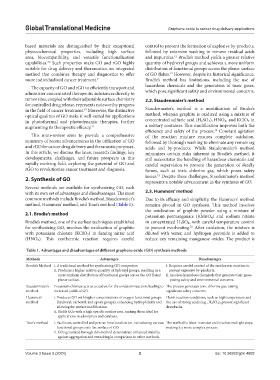
            Table 1. Advantages and disadvantages of different graphene oxide (GO) synthesis methods
            Methods                         Advantages                               Disadvantages
            Brodie’s Method i. A traditional method for synthesizing GO composites.  i.  Requires careful control of the exothermic reaction to
                        ii.  Produces a higher relative quantity of hydroxyl groups, resulting in a   prevent explosive by-products.
                          more uniform distribution of functional groups across the GO flakes’   ii.  Involves hazardous chemicals that generate toxic gases,
                          planar surface.                                posing safety and environmental concerns.
            Staudenmaier’s   Potassium chlorate acts as a catalyst for the oxidation reaction, leading to  The process generates toxic chlorine gas, raising
            method      increased yields of GO.                         significant safety concerns.
            Hummers’    i.  Produces GO with higher concentrations of oxygen functional groups   Harsh reaction conditions, such as high temperature and
            method       (hydroxyl, carboxyl, and epoxy groups), enhancing hydrophilicity and   the use of strong acids (e.g., H₂SO₄), present significant
                         allowing for surface modification.             drawbacks.
                        ii.  Yields GOs with a high specific surface area, making them ideal for
                          applications in adsorption and catalysis.
            Tour’s method  i.  Facilitates controlled and precise functionalization, introducing various  The method is labor-intensive and involves multiple steps,
                         functional groups onto the surface of GO.      making it a more complex process.
                        ii.  GOs generated through this method demonstrate enhanced stability
                          against aggregation and restacking in comparison to other methods.


            Volume 3 Issue 3 (2024)                         2                               doi: 10.36922/gtm.4602

