


Page 53 - IJAMD-1-1
P. 53
International Journal of AI
            for Material and Design                                               Integrating physics data for DL in DED


              The highlight of this study lies in the integration   were conducted using central composite design (CCD)
            of in-process data, which is unattainable through   and curve fitting with a response surface methodology
            experimentation. Pre-process and post-process data   (RSM) regression model, yielding 20 samples of results.
            obtained experimentally encompass laser power (LP),   The parameter ranges were set as follows: LP ranged
            powder  mass  flow  rate  (PMFR),  scanning  speed  (SS),   from 1000 W to 1600W, PMFR varied between 14 g/min
            and melt pool contour. These sets of data will be referred   and 18  g/min,  and SS spanned from 1000  nm/min to
            to as experimental datasets in the subsequent sections.   1600 mm/min. For constructing the CCD, a three-level
            Conversely, the in-process and post-process data obtained   design (-1, 0, +1) was employed, resulting in a 2-level,
            from physics-based simulation include LP, PMFR, SS, sulfur   3-factor full factorial design with repeated center
            content, and melt pool contour, collectively known as the   points. Axial points were calculated using the following
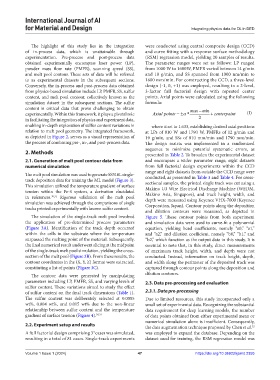
            simulation dataset in the subsequent sections. The sulfur   formula:
            content is critical data that prove challenging to obtain             max min−
            experimentally. Within this framework, it plays a pivotal role   Axial points =  ±  α *  +  centerpoint  (I)
            in facilitating the integration of physics and experiment data,           2
            enabling in-depth exploration of sulfur content variations in   where α set to 1.633, establishing desired axial positions
            relation to melt pool geometry. The integrated framework,   at LPs of 810 W and 1790 W, PMFRs of 12  g/min and
            as depicted in Figure 2, serves as a visual representation of   19  g/min,  and  SSs  of  810  mm/min  and  1790  mm/min.
            the process of combining pre-, in-, and post-process data.  The design matrix was implemented in a randomized
                                                               sequence to minimize potential systematic errors, as
            2. Methods                                         presented in Table 2. To broaden the experimental dataset
            2.1. Generation of melt pool contour data from     and encompass a wider parameter range, eight datasets
            numerical simulation                               from full factorial design experiments within the CCD
                                                               range and eight datasets from outside the CCD range were
            The melt pool simulation was used to generate SS316L single-  conducted, as presented in Table 3 and Table 4. For cross-
            track deposition data for training the ML model (Figure 3).   sectional samples, the printed single track was cut using a
            This simulation utilized the temperature gradient of surface   Makino U3 Wire Electrical Discharge Machine (WEDM,
            tension within the Fe-S system, a derivation elucidated   Makino Asia, Singapore), and track height, width, and
            in references. 30,31  Rigorous validation of the melt pool   depth were measured using Keyence VHX-7000 (Keyence
            simulation was achieved through the comparisons of single   Corporation, Japan). Contour points along the deposition
            tracks printed experimentally with known sulfur content.
                                                               and dilution contours were measured, as depicted in
              The simulation of the single-track melt pool involved   Figure  5. These contour points from both experiment
            the application of pre-determined process parameters   and simulation data were used to curve-fit a polynomial
            (Figure  3A). Identification of the track depth occurred   equation, yielding bead coefficients, namely “a0,” “a1,”
            within  the  cells  in  the substrate  where  the  temperature   and “a2,” and dilution coefficient, namely “b0,” “b1,” and
            surpassed the melting point of the material. Subsequently,   “b2,” which function as the output data in this study. It is
            the final numerical result underwent slicing at the midpoint   essential to note that, in this study, direct measurements
            of the single-track melt pool simulation, yielding the cross-  of maximum track height, width, and depth were not
            section of the melt pool (Figure 3B). From these results, the   conducted. Instead, information on track height, depth,
            contour coordinates in the (X, Y, Z) format were extracted,   and width along the perimeter of the deposited track was
            constituting a list of points (Figure 3C).         captured through contour points along the deposition and
              The contour data were generated by manipulating   dilution contours.
            parameters including LP, PMFR, SS, and varying levels of   2.3. Data pre-processing and evaluation
            sulfur content. These variations aimed to study the effect
            of sulfur content on the final track dimensions (Table 1).   2.3.1. Data pre-processing
            The sulfur content was deliberately selected at 0.0005   Due to limited resources, this study incorporated only a
            wt%, 0.004 wt%, and 0.015 wt% due to the non-linear   small set of experimental data. Recognizing the substantial
            relationship between sulfur content and the temperature   data requirement for deep learning models, the number
            gradient of surface tension (Figure 4). 30,31      of data points obtained from either experimental mean or
                                                               numerical simulation alone is insufficient. Consequently,
            2.2. Experiment setup and results                  the data augmentation technique proposed by Chen et al.
                                                                                                            32
            A full factorial design comprising 3  cases was simulated,   was employed to expand the database. Depending on the
                                         4
            resulting in a total of 81 cases. Single-track experiments   dataset used for training, the RSM regression model was

            Volume 1 Issue 1 (2024)                         47                      https://doi.org/10.36922/ijamd.2355

