


Page 64 - IJAMD-1-1
P. 64
International Journal of AI
            for Material and Design                                               Integrating physics data for DL in DED


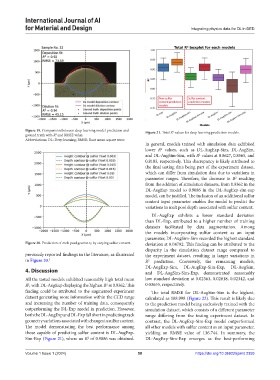
            Figure 19. Comparison between deep learning model prediction and   Figure 21. Total R  values for deep learning prediction models.
                                                                          2
                         2
            ground truth with R  and RMSE value.
            Abbreviations: DL: Deep learning; RMSE: Root mean square error.
                                                               In general, models trained with simulation data exhibited
                                                                     2
                                                               lower  R  values, such as DL-AugExp-Sim, DL-AugSim,
                                                               and DL-AugSim-Sim, with R  values at 0.8627, 0.8565, and
                                                                                      2
                                                               0.8103, respectively. This discrepancy is likely attributed to
                                                               the final testing data being part of the experiment dataset,
                                                               which can differ from simulation data due to variations in
                                                                                                     2
                                                               parameter ranges. Therefore, the decrease in  R  resulting
                                                               from the addition of simulation datasets, from 0.9362 in the
                                                               DL-AugExp model to 0.9086 in the DL-AugExp-sim-exp
                                                               model, can be justified. The inclusion of an additional sulfur
                                                               content input parameter enables the model to predict the
                                                               variations in melt pool depth associated with sulfur content.
                                                                 DL-AugExp exhibits a lower standard deviation
                                                               than DL-Exp, attributed to a higher number of training
                                                               datasets facilitated by data augmentation. Among
                                                               the models incorporating sulfur content as an input
                                                               parameter, DL-AugSim-Sim recorded the highest standard
            Figure 20. Prediction of melt pool geometry by varying sulfur content.  deviation at 0.04792. This finding can be attributed to the
                                                               disparity in the simulation dataset range compared to
            previously reported findings in the literature, as illustrated   the experiment dataset, resulting in larger variations  in
            in Figure 20. 2                                    R  prediction. Conversely, the remaining models,
                                                                2
                                                               DL-AugExp-Sim, DL-AugExp-Sim-Exp, DL-AugSim,
            4. Discussion                                      and DL-AugSim-Sim-Exp, demonstrated reasonably
            All the tested models exhibited reasonably high total mean   low standard deviation at 0.02363, 0.02818, 0.02342, and
             2
            R , with DL-AugExp displaying the highest R  at 0.9362. This   0.03655, respectively.
                                              2
            finding could be attributed to the augmented experiment   The total RMSE for DL-AugSim-Sim is the highest,
            dataset generating more information within the CCD range   calculated as 188.998 (Figure 22). This result is likely due
            and increasing the number of training data, consequently   to the prediction model being exclusively trained with the
            outperforming the DL-Exp model in prediction. However,   simulation dataset, which consists of a different parameter
            both the DL-AugExp and DL-Exp fall short in predicting track   range differing from the testing experiment dataset. In
            geometry variations associated with changes in sulfur content.   contrast, the DL-AugExp-Sim-Exp model outperformed
            The model demonstrating the best performance among   all other models with sulfur content as an input parameter,
            those capable of predicting sulfur content is DL-AugExp-  yielding an RMSE value of 136.744. In summary, the
            Sim-Exp (Figure 21), where an R  of 0.9086 was obtained.   DL-AugExp-Sim-Exp emerges as the  best-performing
                                      2

            Volume 1 Issue 1 (2024)                         58                      https://doi.org/10.36922/ijamd.2355

