


Page 61 - IJAMD-1-1
P. 61
International Journal of AI
            for Material and Design                                               Integrating physics data for DL in DED


            to establish a performance benchmark, employing the   16 nodes. This model was trained with 125 augmented
            TensorFlow library. 38,39  Each model adhered to the training   experiment data points and subsequently tested with 10
            data listed in  Table 6 and was tested on ten experiment   experiment data points. The experiment data include input
            results unseen by the ML model. The nomenclature and   parameters such as LP, PMFR, and SS. The augmentation
            characteristics of the deep learning model are detailed below:  procedure, illustrated in  Figure  6, involves curve-fitting

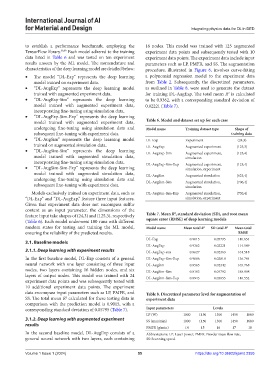
            •   The  model  “DL-Exp”  represents  the  deep learning   a polynomial regression model to the experiment data
               model trained on experiment data.               from  Table 2. Subsequently, the discretized parameters,
            •   “DL-AugExp” represents the deep learning model   as outlined in Table 8, were used to generate the dataset
               trained with augmented experiment data.         for training DL-AugExp. The total mean R  is calculated
                                                                                                  2
            •   “DL-AugExp-Sim” represents the  deep learning   to be 0.9362, with a corresponding standard deviation of
               model trained with augmented experiment data,   0.02221 (Table 7).
               incorporating fine-tuning using simulation data.
            •   “DL-AugExp-Sim-Exp” represents the deep learning
               model trained with augmented experiment data,   Table 6. Model and dataset set up for each case
               undergoing fine-tuning using simulation data and   Model name    Training dataset type  Shape of
               subsequent fine-tuning with experiment data.                                        training data
            •   “DL-AugSim” represents the deep learning model   DL-Exp         Experiment            (24,3)
               trained on augmented simulation data.           DL-AugExp        Augmented experiment  (125,3)
            •   “DL-AugSim-Sim” represents the deep learning   DL-AugExp-Sim    Augmented experiment,   (125,4)
               model  trained  with  augmented  simulation  data,               simulation
               incorporating fine-tuning using simulation data.  DL-AugExp-Sim-Exp  Augmented experiment,   (125,4)
            •   “DL-AugSim-Sim-Exp” represents the deep learning                simulation, experiment
               model  trained  with  augmented  simulation  data,   DL-AugSim   Augmented simulation  (625,4)
               undergoing fine-tuning using simulation data and
               subsequent fine-tuning with experiment data.    DL-AugSim-Sim    Augmented simulation,   (706,4)
                                                                                simulation
              Models exclusively trained on experiment data, such as   DL-AugSim-Sim-Exp  Augmented simulation,   (730,4)
            “DL-Exp” and “DL-AugExp,” feature three input features.             simulation, experiment
            Given that experiment data does not encompass sulfur
            content as an input parameter, the dimensions of the
                                                                           2
            feature input take shapes of (24,3) and (125,3), respectively   Table 7. Mean R , standard deviation (SD), and root mean
            (Table 6). Each model underwent 100 runs with different   square error (RMSE) of deep learning models
            random states for testing and training the ML model,   Model name  Mean total R 2  SD total R 2  Mean total
            ensuring the reliability of the predicted results.                                        RMSE
                                                               DL-Exp             0.9015    0.05795   140.654
            3.1. Baseline models
                                                               DL-AugExp          0.9362    0.02221   114.589
            3.1.1. Deep learning with experiment results       DL-AugExp-sim      0.8627    0.02363   161.518
            In the first baseline model, DL-Exp consists of a general   DL-AugExp-Sim-Exp  0.9086  0.02818  136.744
            neural network with one layer consisting of three input   DL-AugSim   0.8565    0.02342   165.768
            nodes, two layers containing 16 hidden nodes, and six   DL-AugSim-Sim  0.8103   0.04792   188.998
            layers of output nodes. This model was trained with 24   DL-AugSim-Sim-Exp  0.8943  0.03655  146.552
            experiment data points and was subsequently tested with
            10 additional experiment data points. The experiment
            data encompass input parameters such as LP, PMFR, and   Table 8. Discretized parameter level for augmentation of
            SS. The total mean R  calculated for these testing data in   experiment data
                             2
            comparison with the prediction model is 0.9015, with a
            corresponding standard deviation of 0.05795 (Table 7).  Input parameters        Levels
                                                               LP (W)          1000   1150  1300   1450   1600
            3.1.2. Deep learning with augmented experiment     SS (mm/min)     1000   1150  1300   1450   1600
            results
                                                               PMFR (g/min)     14    15     16     17     18
            In the second baseline model, DL-AugExp consists of a   Abbreviations: LP: Laser power, PMFR: Powder mass flow rate,
            general neural network with two layers, each containing   SS: Scanning speed.


            Volume 1 Issue 1 (2024)                         55                      https://doi.org/10.36922/ijamd.2355

