


Page 87 - IJAMD-1-2
P. 87
International Journal of AI for
            Materials and Design
                                                                                   AMTransformer for process dynamics


            dynamical dependencies between state and rate properties   the two matrices. This linear operator is adopted as  , as
            within a state across all state transitions in AM. The AM   shown in Equation VII:
            state embedder then applies the Koopman operator                                             (VII)
            repeatedly, capturing the dynamical dependencies in AM
            state transitions within the observable space through the   The decoder part, consisting of a multi-layer neural
            evolution  of  the  AM embedding  vectors,  as  shown  in   network symmetric to the encoder part, reconstitutes the
            Equation V:                                        embedding vectors from the Koopman operator back into
                                                                                            d
                                                                                        e
                                                       (V)     the original physical space, D: ℝ  → ℝ , during training. The
                                                               data representing the AM state obtained from the decoder
              Using the AM state embedding as inputs, the Koopman   can be expressed as Equation VIII:
            operator projects the AM state transitions onto the   Z  = D (ε )                           (VIII)
            embedding state transition in an infinite-dimensional   i+1  i+1
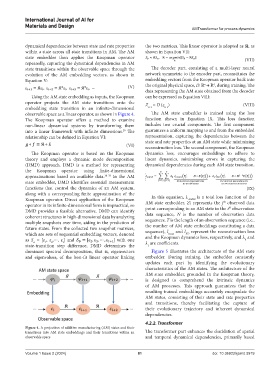
            observable space as a linear operator, as shown in Figure 4.   The  AM state  embedder  is  trained  using  the  loss
            The Koopman operator offers a method to examine    function shown in Equation IX. This loss function
            non-linear dynamical systems by transforming them   includes  two  crucial  components.  The first  component
                                                     29
            into a linear framework with infinite dimensions.  The   guarantees a uniform mapping to and from the embedded
            relationship can be defined in Equation VI:        representation, capturing the dependencies between the
                                                               state and rate properties at an AM state while minimizing
                                                       (VI)    reconstruction loss. The second component, the Koopman
              The Koopman operator is based on the Koopman     dynamics  loss,  encourages  embeddings to  adhere  to
            theory and employs a dynamic mode decomposition    linear dynamics, minimizing errors in capturing the
            (DMD) approach. DMD is a method for representing   dynamical dependencies during each AM state transition.
            the  Koopman  operator using finite-dimensional
            approximations based on available data. 30-35  In the AM
            state embedder, DMD identifies essential measurement
            functions that control the dynamics of an AM system,                                          (IX)
            along  with a corresponding finite approximation of the
            Koopman operator. Direct application of the Koopman   In this equation, L AMSE  is a total loss function of the
                                                                                                th
                                                                                  i
            operator in its infinite-dimensional form is impractical, so   AM state embedder,  Z j represents the  j  observed data
                                                               point corresponding to an AM state in the i  observation
                                                                                                  th
            DMD provides a feasible alternative. DMD can identify
            coherent structures in high-dimensional data by analyzing   data sequence,  N is the number of observation data
            multiple snapshots over time, aiding in the prediction of   sequences, T is the length of an observation sequence (i.e.,
            future states. From the collected two snapshot matrices,   the number of AM state embeddings constituting a data
                                                                            and l  represent the reconstruction loss
                                                               sequence), l
            which are sets of sequential embedding vectors, denoted      recon  KD
            as  S  = [ε ,  ε ,⋯,  ε ] and           with one   and the Koopman dynamics loss, respectively, and λ  and
                                                                                                         0
               a
                    1
                            t
                       2
            state-transition step difference, DMD determines the   λ  are coefficients.
                                                                1
            dominant spectral decomposition, that is, eigenvectors   Figure  5 illustrates the architecture of the AM state
            and eigenvalues, of the best-fit linear operator linking   embedder. During training, the embedder constantly
                                                               updates each part by identifying the evolutionary
                                                               characteristics of the AM states. The architecture of the
                                                               AM state embedder, grounded in the Koopman theory,
                                                               is designed to comprehend the intrinsic dynamics
                                                               of AM processes. This approach guarantees that the
                                                               resulting trained embeddings accurately encapsulate the
                                                               AM states, consisting of their state and rate properties
                                                               and transitions, thereby facilitating the capture of
                                                               their evolutionary trajectory and inherent dynamical
                                                               dependencies.
                                                               4.2.2. Transformer
            Figure 4. A projection of additive manufacturing (AM) states and their
            transitions into AM state embeddings and their transitions within an   The transformer part enhances the elucidation of spatial
            observable space                                   and temporal dynamical dependencies, primarily based


            Volume 1 Issue 2 (2024)                         81                             doi: 10.36922/ijamd.3919

