


Page 92 - IJAMD-1-2
P. 92
International Journal of AI for
            Materials and Design
                                                                                   AMTransformer for process dynamics


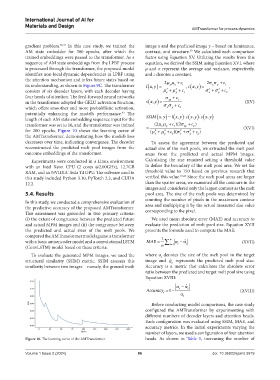
            gradient problem. 40,41  In this case study, we trained the   image x and the predicted image y – based on luminance,
            AM state embedder for 300 epochs, after which the   contrast, and structure.  We calculated each comparison
                                                                                  43
            trained embeddings were passed to the transformer. As a   factor using Equation XV. Utilizing the results from this
            sequence of AM state embeddings from the LPBF process   equation, we derived the SSIM using Equation XVI, where
            is processed through the transformer, the proposed model   µ and σ represent the average and variance, respectively,
            identifies non-local dynamic dependencies in LPBF using   and c denotes a constant.
            the attention mechanism and infers future states based on   2   c         2    c
            its understanding, as shown in Figure 9C. The transformer   lx y,      x  y  1  , cx y ,      x  y  2  ,
            consists of six decoder layers, with each decoder having    x 2    2 y   c 1   x 2   y 2   c 2
            four heads of attention. The feed-forward neural networks    xy   c 3
            in the transformer adopted the GELU activation function,   sx y ,        c            (XV)
            which offers smoother and more probabilistic activation,    x  y  3
            potentially enhancing the model’s performance.  The   SSIM xy,   lx yc xy sx y,   ,   ,
                                                     42
            length of each AM state embedding sequence input for the
            transformer was set to 16, and the transformer was trained     (2 y   c )(2 xy   c )   (XVI)
                                                                      x
                                                                                   2
                                                                           1
            for 200 epochs.  Figure  10 shows the learning curve of   ( 2     c )( 2   2   c )
                                                                       2
            the AMTransformer, demonstrating how the model’s loss   x  y  1   x   y  2
            decreases over time, indicating convergence. The decoder   To assess the agreement between the predicted and
            reconstructed the predicted melt pool images from the   actual size of the melt pools, we extracted the melt pool
            outcome embeddings of the transformer.             areas from the predicted and actual MPM images.
              Experiments were conducted in a Linux environment   Calculating the size required setting a threshold value
            with an Intel Xeon CPU (2 cores @2.00GHz), 12.7GB   to define the boundary of the melt pool area. We set the
            RAM, and an NVIDIA Tesla T4 GPU. The software used in   threshold value to 150 based on previous research that
            this study included Python 3.10, PyTorch 2.3, and CUDA   verified this value. 15,23  Since the melt pool areas are larger
            12.2.                                              than the spatter areas, we examined all the contours in the
                                                               images and considered only the largest contour as the melt
            5.4. Results                                       pool area. The size of the melt pools was determined by
                                                               counting the number of pixels in the maximum contour
            In this study, we conducted a comprehensive evaluation of   area and multiplying it by the actual measured size value
            the predictive accuracy of the proposed AMTransformer.   corresponding to the pixel.
            This assessment was grounded in two primary criteria:
            (i) the extent of congruence between the predicted future   We used mean absolute error (MAE) and accuracy to
            and actual MPM images and (ii) the congruence between   evaluate the prediction of melt pool size. Equation XVII
            the predicted and actual sizes of the melt pools. We   presents the formula used to compute the MAE:
            compared the AMTransformer model against a transformer    1
            with a basic autoencoder model and a convolutional LSTM   MAE  =  ∑ i n =1 α  i  α − ˆ i    (XVII)
            (ConvLSTM) model based on these criteria.                 n
              To evaluate the generated MPM images, we used the   where α  denotes the size of the melt pool in the target
                                                                      i
            structural similarity  (SSIM) metric. SSIM assesses this   image and  α ˆ  represents the predicted melt pool size.
                                                                          i
            similarity between two images – namely, the ground truth   Accuracy is a metric that calculates the absolute error
                                                               ratio between the predicted and target melt pool size using
                                                               Equation XVIII:
                                                                            α  α − ˆ
                                                               Accuracy i  = −1  i α i  i              (XVIII)


                                                                 Before conducting model comparisons, the case study
                                                               configured  the  AMTransformer  by  experimenting  with
                                                               different numbers of decoder layers and attention heads.
                                                               Each configuration was evaluated using SSIM, MAE, and
                                                               accuracy metrics. In the initial experiments varying the
                                                               number of layers, we used a configuration of four attention
            Figure 10. The learning curve of the AMTransformer  heads.  As  shown  in  Table  1,  increasing  the  number  of


            Volume 1 Issue 2 (2024)                         86                             doi: 10.36922/ijamd.3919

