


Page 94 - IJAMD-1-2
P. 94
International Journal of AI for
            Materials and Design
                                                                                   AMTransformer for process dynamics


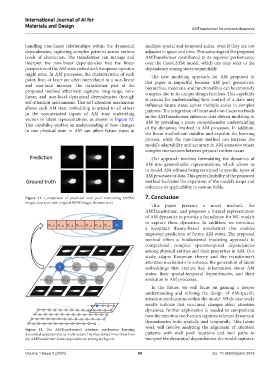
            handling non-linear relationships within the dynamical   multiple spatial and temporal scales, even if they are not
            dependencies, capturing complex patterns across various   adjacent in space and time. This advantage of the proposed
            levels of abstraction. The transformer can manage and   AMTransformer contributed to its superior performance
            interpret  the  non-linear  dependencies  that the  linear   over the ConvLSTM model, which can only refer to the
            perspective of the AM state embedder’s Koopman operator   dependency among states sequentially.
            might miss. In AM processes, the characteristics of each   The new modeling approach for AM proposed in
            point, line, or layer are often interrelated in a non-linear   this paper is impactful because AM part geometries,
            and non-local  manner. The transformer part of the   hierarchies, materials, and functionalities can be extremely
            proposed method effectively captures long-range, non-  complex due to its unique design freedom. This capability
            linear,  and  non-local  dynamical  dependencies  through   is crucial for understanding how control of a state may
            self-attention mechanisms. This self-attention mechanism   influence future states across multiple scales in complex
            allows each AM state embedding to attend  to  all others   patterns. The integration of linear and non-linear methods
            in  the  concatenated  inputs  of  AM  state  embedding   in the AMTransformer enhances data-driven modeling in
            vectors in latent representations, as shown in Figure 12.   AM by providing a more comprehensive understanding
            This capability enables an understanding of how changes   of  the  dynamics  involved  in AM  processes.  In  addition,
            in one physical state in AM can affect future states at
                                                               the linear method can stabilize and expedite the learning
                                                               process, while the non-linear method can increase the
                                                               model’s adaptability and accuracy in AM scenarios where
                                                               complex interactions between physical entities occur.
                                                                 Our approach involves formulating the dynamics of
                                                               AM into generalizable representations, which allows us
                                                               to model AM without being restricted to specific types of
                                                               AM processes or data. This generalizability of the proposed
                                                               method facilitates the expansion of the model’s scope and
                                                               enhances its applicability in various fields.

            Figure  11. Comparison of predicted melt pool monitoring (MPM)   7. Conclusion
            images (top row) with original MPM images (bottom row)
                                                                 This paper  presents a  novel method, the
                                                               AMTransformer, and proposes a formal representation
                                                               of AM dynamics to provide a foundation for ML models
                                                               to capture these dynamics. In addition, we introduce
                                                               a Koopman theory-based transformer that enables
                                                               improved prediction of future AM states. The proposed
                                                               method offers a fundamental modeling approach to
                                                               comprehend complex spatiotemporal dependencies
                                                               among physical entities and their properties in AM. Our
                                                               study adapts  Koopman theory  and the  transformer’s
                                                               attention mechanism to enhance the generation of latent
                                                               embeddings that capture key information about AM
                                                               states, their spatial-temporal dependencies, and their
                                                               evolution in AM processes.

                                                                 In the future, we will focus on gaining a deeper
                                                               understanding and refining the design of AM-specific
                                                               attention mechanisms within the model. While case study
                                                               results indicate that structural changes affect attention
                                                               dynamics, further exploration is needed to comprehend
                                                               how the attention mechanism captures relevant dynamical
                                                               dependencies both  spatially and  temporally.  This future
                                                               work will involve analyzing the alignment of attention
            Figure  12.  The  AMTransformer’s  attention  mechanism  learning
            dynamical dependencies at multi scales: The blue dotted lines show how   patterns with melt pool locations and tool paths to
            the AMTransformer learns dependencies among melt pools  interpret the dynamical dependencies the model captures.


            Volume 1 Issue 2 (2024)                         88                             doi: 10.36922/ijamd.3919

