


Page 90 - IJAMD-1-2
P. 90
International Journal of AI for
            Materials and Design
                                                                                   AMTransformer for process dynamics


            5.1. Data selection                                and laser velocity and energy per unit length (mm) as

            To assess the learning capabilities of the AMTransformer,   rate properties of the laser to understand their dynamical
            we utilized the AM metrology testbed (AMMT):       dependencies  and  predict  future  melt  pools.  To  extract
            overhang part X4 dataset, which was created to facilitate   features from the raw data, we performed three types
            the development of data-driven predictive models, as   of pre-processing on the raw MPM images: denoising,
                                                               centering, and cropping, in addition to pre-processing
            referenced in Lane and Yeung.  This dataset was compiled   the control data. These datasets encompass a variety of
                                    39
            through research conducted at the National Institute   dynamic AM phenomena, including but not limited to
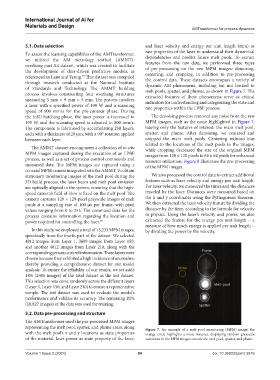
            of Standards and Technology. The AMMT building     melt pools, spatter, and plumes, as shown in Figure 7. The
            process involves constructing four overhang structures   extracted features of these phenomena serve as critical
            measuring 5 mm × 9 mm × 5 mm. The process involves   indicators for understanding and categorizing the state and
            a laser with a specified power of 100 W and a scanning   rate properties within the LPBF process.
            speed of  900  mm/s  for  the  pre-contour  phase.  During
            the infill hatching phase, the laser power is increased to   The denoising process removed any noise from the raw
            195 W, and the scanning speed is adjusted to 800 mm/s.   MPM images, such as the noise highlighted in Figure 7,
            The component is fabricated by accumulating 250 layers,   leaving only the features of interest: the main melt pool,
            each with a thickness of 20 μm, with a 90° rotation applied   spatter, and plume. After denoising, we centered and
            between each layer.                                cropped the main melt pools. Centering reduced bias
                                                               related to the locations of the melt pools in the images,
              The AMMT dataset encompasses a collection of in situ   while cropping decreased the size of the original MPM
            MPM images captured during the execution of an LPBF   images from 120 × 120 pixels to 64 × 64 pixels for enhanced
            process, as well as a set of process control commands and   resource utilization. Figure 8 illustrates the pre-processing
            measured data. The MPM images are captured using a   of the MPM images.
            co-axial MPM camera integrated into the AMMT. To obtain
            stationary monitoring images of the melt pool during the   We also processed the control data to extract additional
            3D build process, the laser beam and melt pool emission   features such as laser velocity and energy per unit length.
            are optically aligned in the system, ensuring that the high-  For laser velocity, we measured the times and the distances
            speed camera’s field of view is fixed on the melt pool. The   traveled by the laser. Distances were measured based on
            camera captures 120 × 120-pixel grayscale images of melt   the x and y coordinates using the Pythagorean theorem.
            pools at a sampling rate of 100 μs per frame, with pixel   We then extracted the laser velocity feature by dividing the
            values ranging from 0 to 255. The command data for the   distance by the time, according to the formula for velocity
            process contains information regarding the location and   in physics. Using the laser’s velocity and power, we also
            power required for controlling the laser. 39       extracted the feature for the energy per unit length – a
                                                               measure of how much energy is applied per unit length –
              In this study, we employed a total of 13,233 MPM images,   by dividing the power by the velocity.
            specifically from the fourth part of the dataset. We selected
            4812 images from Layer 1, 3609 images from Layer 150,
            and another 4812 images from Layer 210, along with the
            corresponding process control information. These layers were
            chosen because they exhibited a high incidence of anomalies,
            thereby providing a comprehensive dataset for our model
            analysis. To ensure the reliability of our results, we set aside
            18% (2406 images) of the total dataset as the test dataset.
            This selection was done randomly across the different layers
            (Layer 1, Layer 150, and Layer 210) to ensure a representative
            sample. The test dataset was used to evaluate the model’s
            performance and validate its accuracy. The remaining 82%
            (10,827 images) of the data was used for training.
            5.2. Data pre-processing and structure

            The AMTransformer used the pre-processed MPM images
            representing the melt pool, spatter, and plume areas, along   Figure  7. An example of a melt pool monitoring (MPM) image: the
            with the melt pool’s x and y locations as state properties   orange circle highlights a noise instance, displaying random greyscale
            of the material, laser power as state property of the laser,   variations in the MPM images outside the melt pool, spatter, and plume


            Volume 1 Issue 2 (2024)                         84                             doi: 10.36922/ijamd.3919

