


Page 15 - IJAMD-1-3
P. 15
International Journal of AI for
            Materials and Design
                                                                              Smart cockpit design with generative models


            virtual environment. The psychological facilitates real-time   references to the designer and engineer. The designer
            monitoring of the user’s mental health status, providing a   agent is responsible for generating the design solution and
            non-invasive method for continuous psychological well-  balancing esthetics and functionality. The engineer agent
            being tracking. The biological model simulates specific   ensures the manufacturability and structural integrity of
            internal mechanisms at the molecular and cellular levels.   the design solution. Finally, the UX analyst agent evaluates
            Given the diversity of data and the accuracy of HDT   the UX factors of the design and offers suggestions to the
            models, HDT can contribute to personalized design,   designer, thus facilitating the collaborative design process.
            verification, human-machine interaction experiences, and   The automatic design process begins with the user agent
            the applicability of human-centric product design.
                                                               extracting the user’s inputting personalized demands, such
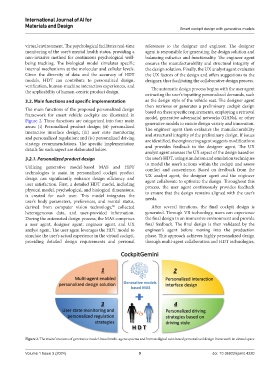
            3.2. Main functions and specific implementation    as the design style of the vehicle seat. The designer agent
                                                               then  retrieves  or  generates  a  preliminary  cockpit  design
            The main functions of the proposed personalized design   based on these specific requirements, employing a retrieval
            framework for smart vehicle cockpits are illustrated in   model, generative adversarial networks (GANs), or other
            Figure 2. These functions are categorized into four main   generative models to ensure design variety and innovation.
            areas: (i) Personalized product design; (ii) personalized   The engineer agent then evaluates the manufacturability
            interactive interface design; (iii) user state monitoring   and structural integrity of the preliminary design. If issues
            and personalized regulation; and (iv) personalized driving   are identified, the engineering agent suggests modifications
            strategy recommendations. The specific implementation   and provides  feedback  to  the designer  agent.  The UX
            details for each aspect are elaborated below.
                                                               analyst agent assesses the UX aspect of the design based on
            3.2.1. Personalized product design                 the user’s HDT, using simulation and emulation techniques
                                                               to model the user’s actions within the cockpit and assess
            Utilizing generative model-based MAS and HDT       comfort and convenience. Based on feedback from the
            technologies to assist in personalized cockpit product   UX analyst agent, the designer agent and the engineer
            design can significantly enhance design efficiency and   agent collaborate to optimize the design. Throughout this
            user satisfaction. First, a detailed HDT model, including   process, the user agent continuously provides feedback
            physical model, psychological, and biological dimensions,   to ensure that the design remains aligned with the user’s
            is created for each user. This model integrates the   needs.
            user’s body parameters, preferences, and mental status,
            derived  from  computer  vision technology,   collected   After several iterations, the final cockpit design is
                                                 50
            heterogeneous data, and user-provided information.   generated. Through VR technology, users can experience
            During the automated design process, the MAS comprises   the final design in an immersive environment and provide
            a user agent, designer agent, engineer agent, and UX   final feedback. The final  design is then  validated by the
            analyst agent. The user agent leverages the HDT model to   engineer’s agent before  moving  into  the production
            simulate the user’s actual experience in the virtual cockpit,   phase. This approach achieves highly personalized design
            providing detailed design requirements and personal   through multi-agent collaboration and HDT technologies,


            Figure 2. The main functions of generative model-based multi-agent systems and human digital twin based personalized design framework in virtual space


            Volume 1 Issue 3 (2024)                         9                              doi: 10.36922/ijamd.4220

