


Page 16 - IJAMD-1-3
P. 16
International Journal of AI for
            Materials and Design
                                                                              Smart cockpit design with generative models


            meeting the unique needs of each user, improving design   signals, other vehicles, and pedestrians. The user-behavior
            efficiency, shortening the design cycle, and ensuring   agent monitors the user’s physiological status derived from
            continuous feedback from the user agent and UX analyst   the individual HDT. The interaction agent dynamically
            agent to guarantee user satisfaction. The integration of   adjusts the interactive interfaces according to the user’s
            these technologies can significantly enhance the quality   preferences and the current environment information to
            and efficiency of personalized cockpit product design.  provide real-time feedback and suggestions. This includes
                                                               adjusting the information hierarchy, displaying real-time
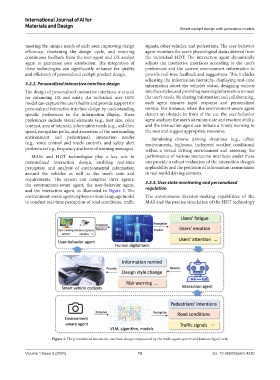
            3.2.2. Personalized interactive interface design   information about the vehicle’s status, designing various

            The design of personalized interactive interfaces is crucial   interface styles, and providing warning information to meet
            for enhancing UX and safety. An individual user HDT   the user’s needs. By sharing information and collaborating,
            model can capture the user’s habits and provide support for   each agent ensures rapid response and personalized
            personalized interactive interface design by understanding   service. For instance, when the environment-aware agent
            specific preferences in the information display. These   detects an obstacle in front of the car, the user-behavior
            preferences include visual elements (e.g., font size, color   agent analyzes the user’s attention state and reaction ability,
            contrast, area of interest), information needs (e.g., real-time   and the interaction agent can initiate a timely warning to
            speed, navigation paths, and awareness of the surrounding   the user and suggest appropriate measures.
            environment and pedestrians), interaction modes      Simulating diverse driving situations (e.g., urban
            (e.g., voice control and touch control), and safety alert   environments, highways,  inclement weather  conditions)
            preferences (e.g., frequency and form of warning messages).  within a virtual driving environment and assessing the
              MASs and HDT technologies play a key role in     performance of various interactive interfaces under these
            personalized interaction design, enabling real-time   can provide a robust evaluation of the interaction design’s
            perception and analysis of environmental information   applicability and the precision of information transmission
            around  the  vehicles  as  well  as  the  user’s  state  and   in real-world driving contexts.
            requirements. The system can comprise three agents:
            the environment-aware agent, the user-behavior agent,   3.2.3. User state monitoring and personalized
            and the interaction agent, as illustrated in Figure 3. The   regulation
            environment-aware agent employs a vision-language model   The autonomous decision-making capabilities of the
            to conduct real-time perception of road conditions, traffic   MAS and the precise simulation of the HDT technology


                       Figure 3. The personalized interactive interface design empowered by the multi-agent system and human digital twin


            Volume 1 Issue 3 (2024)                         10                             doi: 10.36922/ijamd.4220

