


Page 43 - IJAMD-1-3
P. 43
International Journal of AI for
            Materials and Design
                                                                                  Metal AM porosity prediction using ML


                        A                                           B


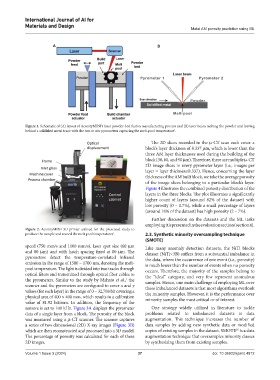
            Figure 1. Schematic of (A) layout of AconityMINI’s laser powder-bed fusion manufacturing process and (B) laser beam melting the powder and leaving
            behind a solidified metal trace with the two in situ pyrometers capturing the melt-pool temperature . 1

                                                                 The 2D slices recorded in the µ-CT scan each cover a
                                                               block’s layer thickness of 8.337 µm, which is lower than the
                                                               three AM layer thicknesses used during the building of the
                                                               block (30, 60, and 90 µm). Therefore, there are multiple µ-CT
                                                               2D image slices in every pyrometer layer (i.e., images per
                                                               layer = layer thickness/8.337). Hence, concerning the layer
                                                               thickness of the AM built block, we take the average porosity
                                                               of the image slices belonging to a particular block’s layer.
                                                               Figure 4 illustrates the combined porosity distribution of the
                                                               layers in the three blocks. The plot illustrates a significantly
                                                               higher  count  of  layers  (around  82%  of  the  dataset)  with
                                                               low porosity (0 – 0.7%), while a small percentage of layers
                                                               (around 18% of the dataset) has high porosity (2 – 7%).
                                                                 Further  discussion  on the  datasets  and the  ML  tasks
                                                               employing it is presented in the evaluation section (section 4).
            Figure 2. AconityMINI 3D printer utilized for the presented study to
            produce the sample and record the melt pool temperatures . 1  2.3. Synthetic minority oversampling technique
                                                               (SMOTE)
            speed (750 mm/s and 1100 mm/s), laser spot size (60 µm   Like many anomaly detection datasets, the NiTi blocks
            and 80  µm) and with hatch spacing fixed at 80  µm. The   dataset (NiTi×3B) suffers from a substantial imbalance in
            pyrometers detect the temperature-correlated infrared   the data, where the occurrence of one event (i.e., porosity)
            emission in the range of 1500 – 1700 nm, denoting the melt-  is much lower than the number of events when no porosity
            pool temperature. The light is divided into two tracks through   occurs. Therefore, the majority of the samples belong to
            optical filters and transmitted through optical fiber cables to   the “ideal” category, and very few represent anomalous
            the pyrometers. Similar to the study by Mahato et al.,  the   samples. Hence, one main challenge of employing ML over
                                                       1
            scanner and the pyrometers are configured to cover x and y   these imbalanced datasets is that most algorithms overlook
            values (for each layer) in the range of 0 – 32,768 bit covering a   the minority samples. However, it is the performance over
            physical area of 400 × 400 mm, which results in a calibration   minority samples the most critical or of interest.
            value of 81.92 bit/mm. In addition, the frequency of the
            sensors is set to 100 kHz. Figure 3A displays the pyrometer   One  strategy  widely  utilized  in  literature  to  tackle
            data of a single layer from a block. The porosity of the block   problems related to imbalanced datasets is data
            was measured using a µ-CT scanner. The scanner captures   augmentation. This technique increases the number of
            a series of two dimensional (2D) X-ray images (Figure 3B)  data samples by adding new synthetic data or modified
            which are then reconstructed and processed into a 3D model.    copies of existing samples in the dataset. SMOTE  is a data
                                                                                                     35
            The percentage of porosity was calculated for each of these   augmentation technique that oversamples minority classes
            2D images.                                         by synthesizing them from existing samples.

            Volume 1 Issue 3 (2024)                         37                             doi: 10.36922/ijamd.4812

