


Page 48 - IJAMD-1-3
P. 48
International Journal of AI for
            Materials and Design
                                                                                  Metal AM porosity prediction using ML


            a layer is critical in the manufacturing process since a slight   separately on the “low” and “high” datasets were trained.
            variance in the porosity at this level could affect the overall   Then, the models evaluate their performance on the unseen
            quality of the built product.                      held-out test dataset. Figure 9 illustrates the absolute error
                                                               and RMSE scores of the two models. The black dotted line
              As shown in  Figure  7, the significant split in the
            distribution (x-axis) observed in Figure 3 is absent once   represents the identity line, and the red line denotes the
            we split the dataset. Hence, there is no clear distinction   line of best fit.
            between the two distributions once we separate the dataset   Figure 10A shows the performance of the XT regressor
            into “low” and “high” subsets. Therefore, predicting   on the “low” porosity dataset. The model achieves a low
            the porosity level should be more challenging than   RMSE  score  of  0.0367,  echoed  in  the  absolute  n  error
            classification.                                    plot, as the best-fit line fairly aligns with the identity line.
                                                               Likewise, the model has also achieved a relatively low RMSE
            3. Results and discussion                          score of 0.108 on the “high” porosity dataset (Figure 10B).

            3.1. Regression                                    However, the best-fit line has a slightly different slope
                                                               compared to the “low” dataset result, showcasing a slightly
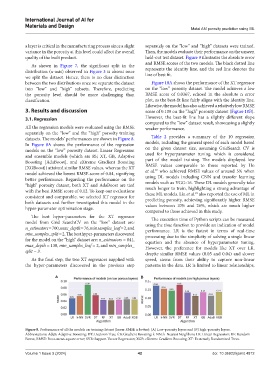
            All the regression models were evaluated using the RMSE   weaker performance.
            separately on the “low” and the “high” porosity training
            datasets. The models’ performances are shown in Figure 8.   Table 2 provides a summary of the 10 regression
            In  Figure  8A shows the performance of the regression   models, including the general speed of each model based
            models on the “low” porosity dataset. Linear Regression   on  the  given  dataset  size,  assuming  GridSearch  CV  is
            and ensemble models (which are RF, XT, GB, Adaptive   used for hyperparameter tuning, which is considered
            Boosting  [AdaBoost],  and  eXtreme  Gradient  Boosting   part of the model training. The models displayed low
            [XGBoost]) attained similar RMSE values, whereas the XT   RMSE  values  comparable  to  those  reported  by  Ho
                                                                   57
            model achieved the lowest RMSE score of 0.04, signifying   et al.   who  achieved  RMSE  values  of  around  5%  when
            better performance. Regarding the performance on the   using DL models including CNN and transfer learning
            “high” porosity dataset, both XT and AdaBoost are tied   models such as VGG‑16. These DL models generally take
                                                               much longer to train, highlighting a strong advantage of
            with the best RMSE score of 0.12. To keep our evaluations               21
            consistent and comparable, we selected XT regressor for   these ML models. Liu et al.  also reported the use of ML in
            both datasets and further investigated this model in the   predicting porosity, achieving significantly higher RMSE
                                                               values  between  10%  and  26%,  which  are  much  higher
            hyper-parameter optimization stage.
                                                               compared to those achieved in this study.
              The best hyper-parameters for the XT regressor     The execution time of Python scripts can be measured
            model  from  Grid  SearchCV  on  the  “low”  dataset  are:   using the time function to provide an indication of model
            n_estimators = 700, max_depth = 76, min samples_leaf = 2, and   performance. LR is the fastest in terms of real-time
            min_samples_split = 2. The best hyper-parameters discovered   processing due to the simplicity of solving a single linear
            for the model on the “high” dataset are: n_estimators = 841,   equation and the absence of hyperparameter tuning.
            max_depth = 138, min_samples_leaf = 2, and min_samples_  However, the preference for models like XT over LR,
            split = 3.
                                                               despite similar RMSE values (0.05 and 0.04) and slower
              As the final step, the two XT regressors supplied with   speed, stems from their ability to capture non-linear
            the hyper-parameters discovered in the previous step   patterns in the data. LR is limited to linear relationships,

                         A                                   B


            Figure 8. Performance of all the models on training dataset (lower RMSE is better): (A) Low‑porosity layers and (B) high‑porosity layers.
            Abbreviations: AdaB: Adaptive Boosting; DT: Decision Tree; GB: Gradient Boosting; k-NN: k-Nearest Neighbors; LR: Linear Regression; RF: Random
            Forest; RMSE: Root‑mean‑square error; SVR: Support Vector Regression; XGB: eXtreme Gradient Boosting; XT: Extremely Randomized Trees.


            Volume 1 Issue 3 (2024)                         42                             doi: 10.36922/ijamd.4812

