


Page 50 - IJAMD-1-3
P. 50
International Journal of AI for
            Materials and Design
                                                                                  Metal AM porosity prediction using ML


            mechanism allows it to handle complex patterns in the   Repeated Stratified K‑Fold with the number of splits and
            data efficiently, while also offering adaptability through   repeats was employed. The system is only exposed to the
            hyperparameter tuning, making it a popular choice in ML   training  data  for hyperparameter  optimization.  Figure  9
            literature for large-scale classification tasks. Conversely,   illustrates the model accuracies across the training
            k-NN, though less efficient with large datasets due to   instances (i.e., iterations). Here, it can be observed that the
            the need to compute distances between all points, was   best parameters render a mean accuracy of the k-NN model
            used for its simplicity and interpretability. It provides a   around 69% on training data. The k‑NN model was trained
            straightforward approach to classification by relying on   on training data supplied with the best parameters obtained
            proximity in feature space. By employing both models,   in the previous step and evaluated it on the held-out test
            we ensure that XGBoost handles complex, non-linear   data. As a result, the model predicts the classes of the held-
            classifications efficiently, while k-NN provides a valuable   out samples with an accuracy of 65%. Undergoing a cross‑
            comparison through its simpler, distance-based approach.  validated hyper-parameter tuning process for XGBoost on
              For obtaining the best set of parameters of the k-NN   training data, the best set of parameters obtained are as
            and  XGBoost  model,  Grid  SearchCV  from  the  sklearn3   follows: learning rate = 0.01, estimators = 400, gamma = 5,
            library was employed. For the cross-validation mechanism,   max depth = 5, min child weight = 10, subsample = 1.0,
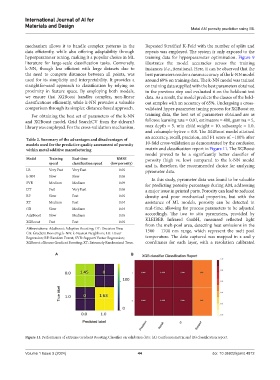
                                                               and colsample-bytree = 0.8. The XGBoost model attained
            Table 2. Summary of the advantages and disadvantages of   an accuracy, recall, precision, and F1 score of ~100% after
            models used for the predictive quality assessment of porosity   10-fold cross-validation as demonstrated by the confusion
            within metal additive manufacturing                matrix and classification report in Figure 11. The XGBoost
                                                               model proved to be a significantly better classifier of
            Model     Training   Real‑time         RMSE        porosity (high vs. low) compared to the k-NN model
                      speed     classification speed  (low porosity)
                                                               and is, therefore, the recommended choice for analyzing
            LR        Very Fast  Very Fast          0.05       pyrometer data.
            k-NN      Slow      Slow                0.06         In this study, pyrometer data was found to be valuable
            SVR       Medium    Medium              0.09       for predicting porosity percentage during AM, addressing
            DT        Fast      Very Fast           0.06       a major issue in printed parts. Porosity can lead to reduced
            RF        Slow      Fast                0.05       density and poor mechanical properties, but with the
            XT        Medium    Fast                0.04       assistance of ML models, porosity can be detected in
            GB        Slow      Medium              0.04       real-time, allowing for process parameters to be adjusted
            AdaBoost  Slow      Medium              0.05       accordingly.  The  two  in situ  pyrometers,  provided  by
            XGBoost   Fast      Fast                0.05       KLEIBER  Infrared  GmbH,  measured  reflected  light
                                                               from the melt-pool area, detecting heat emissions in the
            Abbreviations: AdaBoost: Adaptive Boosting; DT: Decision Tree;   1500 – 1700  nm range, which represent the melt pool
            GB: Gradient Boosting; k-NN: k-Nearest Neighbors; LR: Linear
            Regression; RF: Random Forest; SVR: Support Vector Regression;   temperature. The data captured was mapped in x and y
            XGBoost: eXtreme Gradient Boosting; XT: Extremely Randomized Trees.  coordinates for each layer, with a resolution calibrated

                         A                               B


            Figure 11. Performance of eXtreme Gradient Boosting Classifier on validation data: (A) Confusion matrix and (B) classification report.


            Volume 1 Issue 3 (2024)                         44                             doi: 10.36922/ijamd.4812

