


Page 49 - IJAMD-1-3
P. 49
International Journal of AI for
            Materials and Design
                                                                                  Metal AM porosity prediction using ML


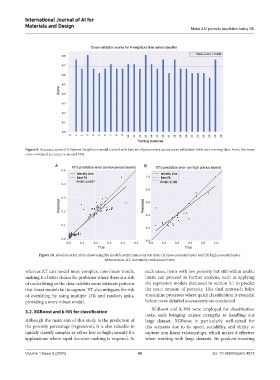
            Figure 9. Accuracy score of k-Nearest Neighbors model trained with best set of parameters across cross-validation folds over training data. Here, the mean
            cross‑validated accuracy is around 69%.

                         A                                    B


                  Figure 10. Absolute error plots showcasing the model’s performance on test data: (A) Low-porosity layers and (B) high-porosity layers.
                                             Abbreviation: XT: Extremely randomized trees.

            whereas XT can model more complex, non-linear trends,   such cases, items with low porosity but still within usable
            making it a better choice for problems where there is a risk   limits can proceed to further analysis, such as applying
            of underfitting or the data exhibits more intricate patterns   the regression models discussed in section 3.1 to predict
            that linear models fail to capture. XT also mitigates the risk   the exact amount of porosity. This dual approach helps
            of overfitting by using multiple DTs and random splits,   streamline processes where quick classification is essential
            providing a more robust model.                     before more detailed assessments are conducted.
                                                                 XGBoost and k-NN were employed for classification
            3.2. XGBoost and k-NN for classification
                                                               tasks, each bringing unique strengths to handling our
            Although the main aim of this study is the prediction of   large dataset. XGBoost is particularly well-suited for
            the porosity percentage (regression), it is also valuable to   this scenario due to its speed, scalability, and ability to
            quickly classify samples as either low or high porosity for   capture non-linear relationships, which makes it effective
            applications where rapid decision-making is required. In   when working with large datasets. Its gradient-boosting


            Volume 1 Issue 3 (2024)                         43                             doi: 10.36922/ijamd.4812

