


Page 47 - IJAMD-1-3
P. 47
International Journal of AI for
            Materials and Design
                                                                                  Metal AM porosity prediction using ML


            Elimination  with  Cross‑Validation  (RFECV)  from  the   models using 10-fold cross-validation. For the cross-
            Scikit‑learn library on the post‑SMOTE‑ENN or SMOTER   validation  mechanism  (repeated  Stratified  K‑Fold  with
            dataset to achieve this. The idea is to eliminate irrelevant   the number of splits and repeats was employed). Based on
            features for the intended ML task that TS-Fresh might   the cross-validated scores obtained by these models, we
            have  introduced.  Furthermore,  we  split  the  final  dataset   selected the best performing model (model ). In the next
                                                                                                 best
            obtained after the RFECV stage into a train and test dataset   stage,  model best  went through intensive parameter tuning
            of size 67% and 33% of the total observations, respectively.   (cross-validated on the training set) to discover the best
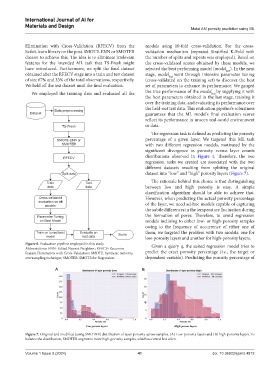
            We held off the test dataset until the final evaluation.  set of parameters to enhance its performance. We gauged
              We employed the training data and evaluated all the   the true performance of the model best  by supplying it with
                                                               the best parameters obtained in the last stage, training it
                                                               over the training data, and evaluating its performance over
                                                               the held-out test data. This evaluation pipeline’s robustness
                        Data preprocessing
              Dataset                                          guarantees that the ML model’s final evaluation scores
                                                               reflect its performance in unseen real-world environment
                           TS-Fresh                            or data.
                                                                 The regression task is defined as predicting the porosity
                         SMOTE-ENN or                          percentage of a given layer. We targeted this ML task
                           SMOTER                              with two different regression models, motivated by the
                                                               significant divergence in porosity versus layer counts
                                                               distributions observed in  Figure  4. Therefore, the two
                            RFECV
                                                               regression tasks we created are associated with the two
                                                               different datasets resulting from splitting the original
                           Split data                          dataset into “low” and “high” porosity layers (Figure 7).
                     Train           Test                        The rationale behind this choice is that distinguishing
                     data            data                      between low and high porosity is easy. A  simple
                                                               classification algorithm  should be able to achieve that.
                  Cross-validated                              However, when predicting the actual porosity percentage
                 evaluation on all                             of the layer, we need ad-hoc models capable of capturing
                    models
                                                               the subtle differences in the temperature fluctuation during
                 Parameter Tuning                              the formation of pores. Therefore, to avoid regression
                  on Best Model                                models inclining to either low- or high-porosity samples
                                                               owing to the frequency of occurrence of either one of
                Train on tuned best  Evaluate on   Score       them, we targeted the problem with two models: one for
                     model          test data                  low-porosity layers and another for high-porosity layers.
            Figure 6. Evaluation pipeline employed in this study   Given a query q, the suited regression model tries to
            Abbreviations: ENN: Edited Nearest Neighbor; RFECV: Recursive
            Feature Elimination with Cross‑Validation; SMOTE: Synthetic minority   predict the exact porosity percentage (i.e., the target or
            oversampling technique; SMOTER: SMOTE for Regression.  dependent variable). Predicting the porosity percentage of

                         A                                   B


            Figure 7. Original and modified (using SMOTER) distribution of layer porosity across samples. (A) Low‑porosity layers and (B) high‑porosity layers. To
            balance the distribution, SMOTER augments more high‑porosity samples, which occurred less often.


            Volume 1 Issue 3 (2024)                         41                             doi: 10.36922/ijamd.4812

