


Page 46 - IJAMD-1-3
P. 46
International Journal of AI for
            Materials and Design
                                                                                  Metal AM porosity prediction using ML


            automotive industries. This has resulted in the availability   evaluating regression models. Lastly, an evaluation matrix,
            of big temporally annotated datasets, generally known as   using previously unseen data, called absolute error matrix,
            time series. Like many others, these time-series datasets   was also employed during model validation.
            may also suffer from poor data quality, noise, missing   The original dataset consists of 586 samples (479 low
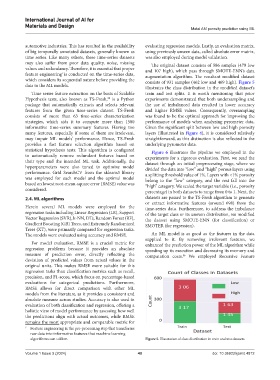
            values and redundancy. Therefore, it is essential that proper   and  107  high),  which  pass  through  SMOTE‑ENN’s  data
            feature engineering is conducted on the time-series data,   augmentation algorithm. The resultant modified dataset
                           1
            which considers its sequential nature before providing the   consists of 931 samples (462 low and 469 high). Figure 5
            data to the ML models.                             illustrates the class distribution in the modified dataset’s
              Time series feature extraction on the basis of Scalable   train and test splits. It is worth mentioning that prior
            Hypothesis  tests,  also  known  as  TS-Fresh,   is  a  Python   experiments demonstrated that both undersampling and
                                               38
            package that automatically extracts and selects relevant   the use of imbalanced data resulted in lower accuracy
            features from the given time-series dataset. TS-Fresh   and  higher  RMSE  values.  Consequently,  oversampling
            consists of more than 63  time-series characterization   was found to be the optimal approach for improving the
            strategies, which aids it to compute more than 1500   performance of models when analyzing pyrometer data.
            informative time-series summary features. Having too   Given the significant split between low and high porosity
            many features, especially if some of them are irrelevant,   layers (illustrated in Figure 4), it is considered relatively
            may impair ML models’ performance. Hence, TS-Fresh   straightforward, as this distinction is also reflected in the
            provides  a  fast  feature  selection  algorithm  based  on   underlying pyrometer data.
            statistical hypothesis  tests. This  algorithm is  configured   Figure  6  illustrates the pipeline we  employed  in the
            to automatically remove redundant features based on   experiments for a rigorous evaluation. First, we read the
            their type and the intended ML task. Additionally, the   dataset through an initial preprocessing stage, where we
            hyperparameters were also tuned to optimize model   divided the data into “low” and “high” porous layers using
            performance.  Grid  SearchCV  from  the  sklearn3  library   a splitting threshold value of 1%. Layers with <1% porosity
            was employed for each model and the optimal model   belong to the “low” category, and the rest fall into the
            based on lowest root‑mean‑square error (RMSE) value was   “high” category. We scaled the target variable (i.e., porosity
            considered.                                        percentage) in both datasets to range from 0 to 1. Next, the
            2.4. ML algorithms                                 datasets are passed to the TS-Fresh algorithm to generate
                                                               or extract informative  features (around 698) from the
            Herein several ML models were employed for the     time-series data. Furthermore, to address the imbalance
            regression tasks including Linear Regression (LR), Support   of the target class or its uneven distribution, we modified
            Vector Regression (SVR), k‑NN, DTs, Random Forest (RF),   the  dataset  using  SMOTE‑ENN  (for  classification)  or
            Gradient Boosting (GB) Trees, and Extremely Randomized   SMOTER (for regression).
            Trees (XT), were primarily compared for regression tasks.
            The models were evaluated using accuracy and RMSE.   An ML model is as good as the features in the data
                                                               supplied to it. By removing irrelevant features, we
              For  model  evaluation,  RMSE  is  a  crucial  metric  for   enhanced the prediction power of the ML algorithm while
            regression problems because  it  provides  an absolute   speeding up its execution and decreasing its memory and
            measure of prediction error, directly reflecting the   computation costs.  We employed Recursive Feature
                                                                               56
            deviation of predicted values from actual values in the
            original  units.  This  makes  RMSE  more  suitable for this
            regression tasks than classification metrics such as recall,
            precision, and F1-score, which focus on percentage-based
            evaluations for categorical predictions. Furthermore,
            RMSE  allows  for  direct  comparison  with  other  ML
            models from the literature, as it provides a consistent and
            absolute measure across studies. Accuracy is also used in
            evaluation of both classification and regression, offering a
            holistic view of model performance by assessing how well
            the predictions align with actual outcomes, while RMSE
            remains the most appropriate and comparable metric for
            1      Feature engineering is the pre-processing step that transforms
              raw data into informative features that machine learning
              algorithms can utilize.                          Figure 5. Illustration of class distribution in train and test datasets


            Volume 1 Issue 3 (2024)                         40                             doi: 10.36922/ijamd.4812

