


Page 38 - IJAMD-2-1
P. 38
International Journal of AI for
            Materials and Design
                                                                            ML molecular modeling of Ru: A KAN approach


                         A                                   B


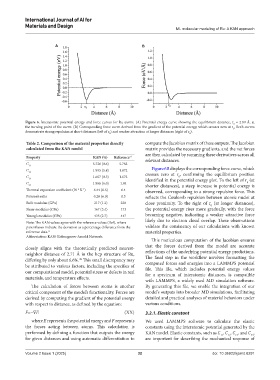
            Figure 6. Interatomic potential energy and force curves for Ru atoms. (A) Potential energy curve showing the equilibrium distance, r  ≈ 2.89 Å, at
                                                                                                    0
            the turning point of the curve. (B) Corresponding force curve derived from the gradient of the potential energy, which crosses zero at r . Both curves
                                                                                                    0
            demonstrate strong repulsion at short distances (left of r ) and weaker attraction at longer distances (right of r ).
                                                0                                 0
            Table 2. Comparison of the material properties directly   compute the Jacobian matrix of these outputs. The Jacobian
            calculated from the KAN model                      matrix provides the necessary gradients, and the net forces
                                                               are then calculated by summing these derivatives across all
            Property                     KAN (%)  Reference 51  relevant distances.
            C 11                         5.726 (0.6)  5.763
            C 12                         1.995 (5.8)  1.872      Figure 6B displays the corresponding force curve, which
            C                            1.667 (0.3)  1.673    crosses zero at r , confirming the equilibrium position
                                                                             0
             13                                                identified in the potential energy plot. To the left of r  (at
            C                            1.966 (6.0)  1.84                                                0
             44                                                shorter distances), a steep increase in potential energy is
            Thermal expansion coefficient (10  K )  6.44 (0.6)  6.4  observed, corresponding to a strong repulsive force. This
                                  -6
                                    -1
            Poisson’s ratio              0.28 (6.0)  0.3       reflects the Coulomb repulsion between atomic nuclei at
            Bulk modulus (GPa)           217 (1.3)  220        close proximity. To the right of r  (at longer distances),
                                                                                           0
            Shear modulus (GPa)          167 (3.4)  173        the potential energy rises more gradually, with the force
            Young’s modulus (GPa)        435 (2.7)  447        becoming negative, indicating a weaker attractive force
            Note: The KAN values agree with the reference values (Ref), where   likely due to electron cloud overlap. These observations
            parentheses indicate the deviation as a percentage difference from the   validate the consistency of our calculations with known
            reference data. 51                                 material properties.
            Abbreviation: KAN: Kolmogorov-Arnold Network.
                                                                 This meticulous computation of the Jacobian ensures
            closely aligns with the theoretically predicted nearest-  that the forces derived from the model are accurate
            neighbor distance of 2.71 Å in the hcp structure of Ru,   reflections of the underlying potential energy predictions.
            differing by only about 6.6%.  This small discrepancy may   The final step in the workflow involves formatting the
                                   38
            be attributed to various factors, including the specifics of   computed forces and energies into a LAMMPS potential
                                                               file. This file, which includes potential energy values
            our computational model, potential stress or defects in real   for a spectrum of interatomic distances, is compatible
            materials, and temperature effects.
                                                               with LAMMPS, a widely used MD simulation software.
              The calculation of forces between atoms is another   By generating this file, we enable the integration of our
            critical component of the model’s functionality. Forces are   model’s outputs into broader MD simulations, facilitating
            derived by computing the gradient of the potential energy   detailed and practical analyses of material behaviors under
            with respect to distance, as defined by the equation:  various conditions.
            F=−∇E                                     (ⅩⅩ)     3.2.1. Elastic constant
              where  represents the potential energy and  represents   We used LAMMPS software to calculate the elastic
            the forces acting between atoms. This calculation is   constants using the interatomic potential generated by the
            performed by defining a function that outputs the energy   KAN model. Elastic constants, such as  ,  ,  , and  ,
                                                                                                     13
                                                                                                            44
                                                                                                  12
                                                                                               11
            for given distances and using automatic differentiation to   are important for describing the mechanical response of
            Volume 2 Issue 1 (2025)                         32                             doi: 10.36922/ijamd.8291

