


Page 39 - IJAMD-2-1
P. 39
International Journal of AI for
            Materials and Design
                                                                            ML molecular modeling of Ru: A KAN approach


            materials to various types of deformation and are integral   temperature was incrementally increased from 300 K
            for analyzing mechanical properties. We optimized the   to  over  4000  K. Throughout this process,  we  closely
            Ru crystal structure to its minimum energy configuration   monitored the system’s thermodynamic properties, such as
            using the potential derived from the KAN model. We   potential energy and volume.
            then subjected the structure to specific strain conditions   To obtain accurate relationships between the different
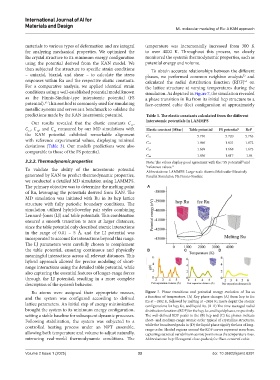
            – uniaxial, biaxial, and shear – to calculate the stress   phases, we  performed common neighbor analysis  and
                                                                                                        53
            responses within Ru and the respective elastic constants.   calculated the radial distribution function (RDF)  on
                                                                                                         54
            For a comparative analysis, we applied identical strain   the lattice structure at varying temperatures during the
            conditions using a well-established potential model known   simulation. As depicted in Figure 7, the simulation revealed
            as the Finnis-Sinclair-type interatomic potential (FS   a phase transition in Ru from its initial hcp structure to a
            potential).  This method is commonly used for simulating   face-centered  cubic  (fcc)  configuration  at  approximately
                    52
            metallic systems and serves as a benchmark to validate the
            predictions made by the KAN interatomic potential.  Table 3. The elastic constants calculated from the different
              Our results revealed that the elastic constants   ,   interatomic potentials in LAMMPS
                                                         11
             ,   , and    measured by our MD simulations with   Elastic constant (Mbar)  Table potential  FS potential a  Ref b
                 13
                        44
             12
            the  KAN  potential  exhibited  remarkable  alignment   C11              5.740       5.720   5.763
            with reference experimental values, displaying minimal                   1.866       1.831   1.872
            deviations (Table 3). Our model’s predictions were also   C12            1.669       1.668   1.673
            comparable to those of the FS potential.           C13
                                                               C44                   1.856       1.817    1.84
            3.2.2. Thermodynamic properties                    Note: The values display good agreement with the:  FS potential  and
                                                                                                        52
                                                                                                a
                                                               b reference values. 51
            To  validate  the  ability  of  the  interatomic  potential   Abbreviations: LAMMPS: Large-scale Atomic/Molecular Massively
            generated by KAN to predict thermodynamic properties,   Parallel Simulator; FS: Finnis-Sinclair.
            we conducted a detailed MD simulation using LAMMPS.
            The primary objective was to determine the melting point   A
            of Ru, leveraging the potentials derived from KAN. The
            MD simulation was initiated with Ru in its hcp lattice
            structure with fully periodic boundary conditions. The
            simulation utilized hybrid/overlay pair styles combining
            Lennard-Jones (LJ) and table potentials. This combination
            ensured a smooth transition to zero at larger distances,
            since the table potential only described atomic interactions
            in  the  range  of  0.01  –  5  Å,  and  the  LJ  potential  was
            incorporated to account for interactions beyond this range.
            The LJ parameters were carefully chosen to complement
            the  table potential, ensuring continuous and physically   B       C              D
            meaningful interactions across all relevant distances. This
            hybrid approach allowed for precise modeling of short-
            range interactions using the detailed table potential, while
            also capturing the essential features of longer-range forces
            through  the  LJ potential,  resulting  in  a more  complete
            description of the system’s behavior.
              Ru atoms were assigned their appropriate masses,   Figure  7.  Phase transitions and potential energy evolution of Ru as
            and the system was configured according to defined   a function of temperature. (A) Key phase changes (A) from hcp to fcc
            lattice parameters. An initial step of energy minimization   Ru at ~1882 K, followed by melting at ~2416 K; insets depict the atomic
                                                               configurations for hcp, fcc, and liquid Ru. (B-D) The time-averaged radial
            brought the system to its minimum energy configuration,   distribution functions (RDF) for the hcp, fcc, and liquid phases, respectively.
            setting a stable baseline for subsequent dynamic processes.   The well-defined RDF peaks in the (B) hcp and (C) fcc phases indicate
            Following  stabilization,  the  system  was  subjected  to  a   short- and medium-range atomic order typical of crystalline structures,
            controlled heating process under  an NPT  ensemble,   while the broadened peaks in (D) the liquid phase signify the loss of long-
                                                               range order. Shaded regions around the RDF curves represent error bars,
            allowing both temperature and volume to adjust naturally,   capturing statistical variability in atomic positions as the temperature rises.
            mirroring real-world thermodynamic conditions. The   Abbreviations: hcp: Hexagonal close-packed; fcc: Face-centered cubic.


            Volume 2 Issue 1 (2025)                         33                             doi: 10.36922/ijamd.8291

