


Page 59 - IJAMD-2-3
P. 59
International Journal of AI for
            Materials and Design                                                Intelligent interactive textile in healthcare


            (vi)   Question 6: How do you feel about the customized   of the POF and yarns used for the fabric development. The
                gesture design aligning with the center’s slogan?  knitting process was conducted on a 14-gauge computerized
            (vii)   Question 7: In what ways did you feel engaged or   v-bed knitting machine, which is an industrial machine and
                connected to the community through the co-design   is able to realize scalable production. To knit out the design
                process?                                       graphics, a knit structure of doubled jacquard in three
            (viii)   Question 8: Do you believe the panels will be adopted   colors was utilized. The design  graphics were separated
                 widely? Do you think elderly users will enjoy and   into three panels. Three fabric panels were knitted, each
                 regularly engage with them?                   with a size of 123 cm in width and 139 cm in height. In
            (ix)   Question 9: Overall, how has participating in the   the first version, the jacquard structure was only knitted
                co-design process influenced your sense of belonging   with wool yarns. However, the illuminated area was not
                to the center and the broader community?       apparent, so the illuminative effect of the fabric panels was
                                                               not satisfactory. Therefore, a transparent yarn was added
              Questions for the end-users focused on interaction   when developing the second version to highlight the
            experience, intuitiveness, comfort, and social aspects of   illuminated area.
            engagement with the panels and included:
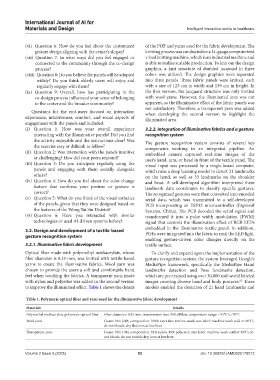
            (i)  Question 1: How was your overall experience   3.2.2. Integration of illuminative fabrics and a gesture
               interacting with the illuminative panels? Did you find   recognition system
               the activity enjoyable and the instructions clear? Was   The gesture recognition system consists of several key
               the exercise easy or difficult to follow?       components working in an integrated pipeline. An
            (ii)  Question 2: Was interaction with the panels intuitive   embedded camera captured real-time images of the
               or challenging? How did your peers respond?     user’s hand, arm, or head in front of the textile panel. The
            (iii) Question 3: Do you anticipate regularly using the   visual input was processed by a single-board computer,
               panels and engaging with them socially alongside   which runs a deep learning model to detect 21 landmarks
               others?                                         on the hand, as well as 33 landmarks on the shoulder
            (iv)  Question 4: How do you feel about the color change   and head. A  self-developed algorithm interpreted these
               feature that confirms your posture or gesture is   landmark data coordinates to classify specific gestures.
               correct?                                        The recognized gestures were then converted into encoded
            (v)  Question 5: What do you think of the visual esthetics   serial data, which was transmitted to a self-developed
               of the panels, given that they were designed based on   PCB  incorporating  an  ESP32  microcontroller  (Espressif
               the features of the Wong Tai Sin District?      Systems, China). The PCB decoded the serial signal and
            (vi) Question 6: Have you interacted with similar   transformed it into a pulse width modulation (PWM)
               technologies or used AI-driven systems before?  signal that controls the illumination effect of RGB LEDs
            3.2. Design and development of a textile-based     embedded  in  the  illuminative  textile  panel.  In  addition,
            gesture recognition system                         POFs were integrated into the fabric to emit the LED light,
                                                               enabling gesture-driven color changes directly on the
            3.2.1. Illuminative fabric development             textile surface.
            Optical fiber made with polymethyl methacrylate, whose   To clarify and expand upon the implementation of the
            fiber diameter is 0.25 mm, was knitted with textile-based   gesture recognition system, the system leveraged Google’s
            yarns  to  create the illuminative  fabrics.  Wool  yarn was   MediaPipe framework, specifically the MediaPipe Hand
            chosen to provide the users a soft and comfortable hand   landmarks detection and Pose landmarks detection,
            feel when touching the fabrics. A transparent yarn made   which are pre-trained using over 30,000 real-world labeled
            with nylon and polyester was added in the second version   images covering diverse hand and body postures.  These
                                                                                                       65
            to improve the illuminated effect. Table 1 shows the details   models enabled the detection of 21 hand landmarks and

            Table 1. Polymeric optical fiber and yarn used for the illuminative fabric development
            Materials                                                     Details
            Polymethyl methacrylate polymeric optical fiber  Fiber diameter: 0.25 mm, transmission loss: 350 dB/km, temperature range: −55°C to 70°C
            Wool yarn                        Count: Nm 2/48; composition: 100% extra fine merino wool; care label: machine wash cold or 40°C;
                                             do not bleach; dry flat; iron at low heat
            Transparent yarn                 Count: Nm 1/80; composition: 55% nylon, 45% polyester; care label: machine wash cold or 30°C; do
                                             not bleach; do not tumble dry; iron at low heat


            Volume 2 Issue 3 (2025)                         53                        doi: 10.36922/IJAMD025170013

