


Page 64 - IJAMD-2-3
P. 64
International Journal of AI for
            Materials and Design                                                Intelligent interactive textile in healthcare


            gesture reliability, thus reducing variation due to angle or   participants  expressing  a  strong  emotional  resonance
            environmental brightness. Although false positives were   rooted in their personal histories and lifelong proximity to
            not formally measured, gesture set definitions were refined   landmarks, such as Lion Rock. Users A and B consistently
            collaboratively with users to minimize misrecognition.   reported high levels of comfort, positively evaluating the
            Only movements that were clearly distinguishable in both   system’s ease of access and intuitive interactions. They
            posture and motion were selected as trigger gestures. This   particularly praised the soft and approachable materials,
            co-design-driven filtering process effectively reduced the   noting their pleasant tactile qualities, which significantly
            risk of unintended activations.                    contributed to overall user satisfaction and engagement. In
              Regarding privacy and ethical considerations, the   addition, users emphasized the system’s inclusive nature,
            image-capturing software does not include any recording   highlighting  how  effectively  the  design  accommodated
            or data storage functions. Images captured by the camera   diverse physical abilities and age groups. The OT lead
            are processed in real time for landmark detection and   (co-design session B) reported improvements in therapeutic
            are continuously overwritten with the next frame. No   outcomes, specifically noting the system’s effectiveness in
            visual data are stored locally or remotely, and all content   enhancing rehabilitation processes. They acknowledged
            is deleted immediately upon device shutdown. As the   that the integration of diverse technologies and intelligent
            textile panels are designed for use in public or semi-public   solutions substantially increased rehabilitation efficiency
            spaces (such as DHC), where CCTV systems are already   and  operational  performance.  Furthermore,  OTs
            in operation, and the use of non-recording cameras falls   emphasized the system’s high level of accessibility and
            within acceptable practices. Nonetheless, privacy concerns   intuitive usability across a broad demographic, supporting
            were considered during the design phase, and the current   user within the age range of 6 to over 80  years old.
            system meets ethical expectations for deployment in   A detailed summary of stakeholder feedback is presented
            environments frequented by elderly users and vulnerable   in Table S2 for the research lead, Table S3 for the OT lead,
            groups.                                            Table S4 for co-designers, and Table S5 for the end-users.
                                                               Complete transcripts of stakeholder interviews are included
            4.5. Stakeholders’ feedback                        in the supplementary materials to ensure comprehensive
            Co-designers’ feedback (co-design session C) highlighted   documentation and research transparency.
            multiple  significant  advantages  of  integrating  textile   The participatory design approach effectively engaged
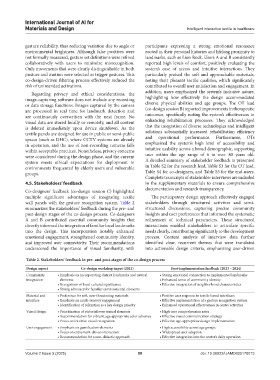
            wall panels with the gesture recognition system.  Table 2   stakeholders through structured activities and semi-
            summarizes the stakeholders’ feedback during the pre- and   structured discussions, capturing precise community
            post-design stages of the co-design process. Co-designers   insights and user preferences that informed the systematic
            A and B contributed essential community insights that   refinement  of  technical  parameters.  These  structured
            directly informed the integration of familiar local landmarks   interactions  enabled  stakeholders  to  articulate  specific
            into the design. This incorporation notably enhanced   needs clearly, contributing significantly to the development
            emotional engagement, strengthened community identity,   process. Content analysis of interview data further
            and improved user connectivity. Their recommendations   identified clear, recurrent themes that were translated
            underscored  the importance of visual familiarity,  with   into actionable design criteria, emphasizing user-driven

            Table 2. Stakeholders’ feedback in pre‑ and post‑stages of the co‑design process

            Design aspect          Co‑design workshop input (2021)        Post‑implementation feedback (2023 – 2024)
            Community     •  Emphasis on incorporating district landmarks and natural   •  Strong emotional connection to implemented landmarks
            integration    elements                                  •  Enhanced sense of community identity
                          •  Recognition of local cultural significance  •  Effective integration of neighborhood characteristics
                          •  Strong advocacy for familiar environmental elements
            Material and   •  Preference for soft, non‑threatening materials  •  Positive user response to textile‑based interfaces
            interface     •  Emphasis on multi‑sensory engagement    •  Effective implementation of a gesture recognition system
                          •  Identification of relaxation as a key design priority  •  Enhanced operational effectiveness in center activities
            Visual design  •  Prioritization of pictorial over textual elements  •  High user comprehension rates
                          •  Recommendation for vibrant, age‑appropriate color schemes  •  Effective visual communication strategy
                          •  Focus on intuitive visual recognition   •  Effective age‑appropriate design implementation
            User engagement  •  Emphasis on gamification elements    •  High accessibility across age groups
                          •  Focus on enjoyment‑driven interaction   •  Widespread user adoption
                          •  Recommendation for a non‑didactic approach  •  Effective integration into the center’s daily operation


            Volume 2 Issue 3 (2025)                         58                        doi: 10.36922/IJAMD025170013

