


Page 62 - IJAMD-2-3
P. 62
International Journal of AI for
            Materials and Design                                                Intelligent interactive textile in healthcare


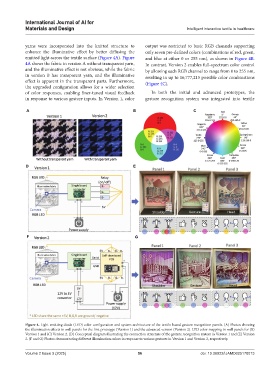
            yarns were incorporated into the knitted structure to   output was restricted to basic RGB channels supporting
            enhance the illuminative effect by better diffusing the   only seven pre-defined colors (combinations of red, green,
            emitted light across the textile surface (Figure 4A). Figure   and blue at either 0 or 255 nm), as shown in Figure 4B.
            4A shows the fabric in version A without transparent yarn,   In contrast, Version 2 enables full-spectrum color control
            and the illuminative effect is not obvious, while the fabric   by allowing each RGB channel to range from 0 to 255 nm,
            in version B has transparent yarn, and the illuminative   resulting in up to 16,777,215 possible color combinations
            effect is apparent in the transparent parts. Furthermore,   (Figure 4C).
            the upgraded configuration allows for a wider selection
            of color responses, enabling finer-tuned visual feedback   In both the initial and advanced prototypes, the
            in response to various gesture inputs. In Version 1, color   gesture recognition system was integrated into textile


            A                                             B                        C


            D                                             E


            F                                             G


            Figure 4. Light-emitting diode (LED) color configuration and system architecture of the textile-based gesture recognition panels. (A) Photos showing
            the illumination effects in wall panels for the first prototype (Version 1) and the advanced version (Version 2). LED color mapping in wall panels for (B)
            Version 1 and (C) Version 2. (D) Conceptual diagram illustrating the connection structure of the gesture recognition system in Version 1 and (E) Version
            2. (F and G) Photos demonstrating different illumination colors in response to various gestures in Version 1 and Version 2, respectively.


            Volume 2 Issue 3 (2025)                         56                        doi: 10.36922/IJAMD025170013

