


Page 72 - IJAMD-2-3
P. 72
International Journal of AI for
            Materials and Design                                          Optimization of membrane shrinkage and stability


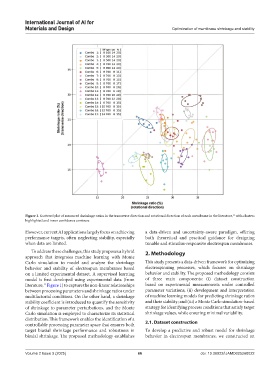
            Figure 1. Scattered plot of measured shrinkage ratios in the transverse direction and rotational direction of each membrane in the literature,  with clusters
                                                                                                    11
            highlighted and inner confidence contours
            However, current AI applications largely focus on achieving   a data-driven and uncertainty-aware paradigm, offering
            performance targets, often neglecting stability, especially   both theoretical and practical guidance for designing
            when data are limited.                             tunable and stimulus-responsive electrospun membranes.
              To address these challenges, this study proposes a hybrid   2. Methodology
            approach that integrates machine learning with Monte
            Carlo  simulation  to  model  and  analyze  the  shrinkage   This study presents a data-driven framework for optimizing
            behavior  and stability of electrospun  membranes  based   electrospinning processes, which focuses on shrinkage
            on a limited experimental dataset. A supervised learning   behavior and stability. The proposed methodology consists
            model is first developed using experimental data (from   of three main components: (i) dataset construction
            literature;  Figure 1) to capture the non-linear relationships   based  on  experimental  measurements  under  controlled
                    11
            between processing parameters and shrinkage ratios under   parameter variations; (ii) development and interpretation
            multifactorial conditions. On the other hand, a shrinkage   of machine learning models for predicting shrinkage ratios
            stability coefficient is introduced to quantify the sensitivity   and their stability; and (iii) a Monte Carlo simulation-based
            of shrinkage to parameter perturbations, and the Monte   strategy for identifying process conditions that satisfy target
            Carlo simulation is employed to characterize its statistical   shrinkage values, while ensuring minimal variability.
            distribution. This framework enables the identification of a
            controllable processing parameter space that ensures both   2.1. Dataset construction
            target biaxial shrinkage performance and robustness in   To develop a predictive and robust model for shrinkage
            biaxial shrinkage. The proposed methodology establishes   behavior in electrospun membranes, we constructed an


            Volume 2 Issue 3 (2025)                         66                        doi: 10.36922/IJAMD025260022

