


Page 77 - IJAMD-2-3
P. 77
International Journal of AI for
            Materials and Design                                          Optimization of membrane shrinkage and stability


            the smallest RMSE (2.00), the highest  R   (0.75), and a   deposition heterogeneity, which were not included in the
                                              2
            relatively low  MAPE  (7.35).  In  contrast,  the  RF, XGBT,   model inputs.
            and DTR models exhibit higher prediction errors in %TD
            forecasting.  The  ANN  and  LR  models  perform  poorly   3.2. Shrinkage stability prediction model
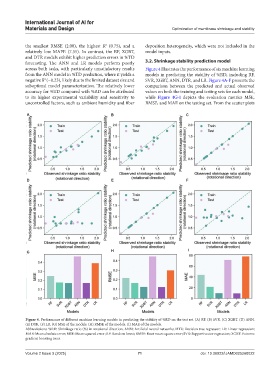
            across both tasks, with particularly unsatisfactory results   Figure 4 illustrates the performance of six machine learning
            from the ANN model in %TD prediction, where it yields a   models in predicting the stability of %RD, including RF,
                    2
            negative R  (−0.23), likely due to the limited dataset size and   SVR, XGBT, ANN, DTR, and LR. Figure 4A-F presents the
            suboptimal model parameterization. The relatively lower   comparison between the predicted and actual observed
            accuracy for %TD compared with %RD can be attributed   values on both the training and testing sets for each model,
            to its higher experimental variability and sensitivity to   while  Figure  4G-I depicts the evaluation metrics MSE,
            uncontrolled factors, such as ambient humidity and fiber   RMSE, and MAE on the testing set. From the scatter plots


            A                                   B                               C


            D                                   E                               F


            G                                   H                                I


            Figure 4. Performance of different machine learning models in predicting the stability of %RD on the test set. (A) RF. (B) SVR. (C) XGBT. (D) ANN.
            (E) DTR. (F) LR. (G) MSE of the models. (H) RMSE of the models. (I) MAE of the models.
            Abbreviations: %RD: Shrinkage ratio (%) in rotational direction; ANN: Artificial neural networks; DTR: Decision tree regressor; LR: Linear regression;
            MAE: Mean absolute error; MSE: Mean squared error; RF: Random forest; RMSE: Root mean square error; SVR: Support vector regression; XGBT: Extreme
            gradient boosting trees.


            Volume 2 Issue 3 (2025)                         71                        doi: 10.36922/IJAMD025260022

