


Page 79 - IJAMD-2-3
P. 79
International Journal of AI for
            Materials and Design                                          Optimization of membrane shrinkage and stability


            lowest values in MSE and RMSE, confirming its superior   indicate the directionality of influence; in other words, they
            accuracy and robustness in modeling  TD stability. In   do not reveal whether an increase in a given parameter
            contrast, the ANN and LR models yield significantly higher   enhances or diminishes stability. Applied voltage and TPU
            errors, indicating poor predictive reliability. Overall, the   concentration consistently rank as the most influential
            results indicate that XGBT is the most effective model for   factors in both RD and TD stability models, underscoring
            predicting %RD stability and %TD stability, outperforming   their critical role in governing shrinkage stability during
            other approaches in both accuracy and robustness.  electrospinning. Voltage controls the electrostatic field
                                                               strength, directly influencing jet acceleration, elongation,
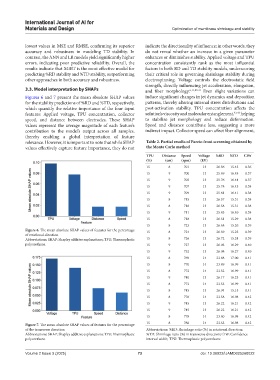
            3.3. Model interpretation by SHAPs                 and fiber morphology. 6,11,39-41  Even slight variations can
            Figures 6 and 7 present the mean absolute SHAP values   induce significant changes in jet dynamics and deposition
            for the stability predictions of %RD and %TD, respectively,   patterns, thereby altering internal stress distributions and
            which quantify the relative importance of the four input   post-activation stability. TPU concentration affects the
            features: Applied voltage, TPU concentration, collector   solution’s viscosity and molecular entanglement, 42,43  helping
            speed, and distance between electrodes. These SHAP   to  stabilize  jet morphology  and reduce  deformation.
            values  represent  the  average  magnitude  of  each  feature’s   Speed and distance contribute less, suggesting a more
            contribution to the model’s output across all samples,   indirect impact. Collector speed can affect fiber alignment,
            thereby  enabling  a global interpretation  of feature
            relevance. However, it is important to note that while SHAP   Table 2. Partial results of Pareto front screening obtained by
            values effectively capture feature importance, they do not   the Monte Carlo method

                                                               TPU    Distance   Speed   Voltage   %RD  %TD  CIW
                                                               (%)     (cm)   (rpm)   (kV)
                                                               15        8     701     13    26.36  15.43  0.36
                                                               15        9     700     13    25.69  16.48  0.37
                                                               15        9     705     13    25.76  16.44  0.37
                                                               15        9     707     13    25.78  16.43  0.38
                                                               15        9     709     13    25.81  16.41  0.38
                                                               15        8     715     13    26.57  15.31  0.38
                                                               15        8     716     13    26.58  15.31  0.38
                                                               15        9     711     13    25.83  16.40  0.38
                                                               15        8     718     13    26.61  15.29  0.38
                                                               15        8     723     13    26.68  15.26  0.39
            Figure 6. The mean absolute SHAP values of features for the percentage   15  8  724  13  26.69  15.25  0.39
            of rotational direction
            Abbreviations: SHAP: Shapley additive explanations; TPU: Thermoplastic   15  8  726  13  26.72  15.24  0.39
            polyurethane.                                      15        9     727     13    26.03  16.29  0.40
                                                               15        9     732     13    26.08  16.27  0.40
                                                               15        8     769     14    23.48  17.00  0.41
                                                               15        8     770     14    23.49  16.99  0.41
                                                               15        8     772     14    23.52  16.99  0.41
                                                               15        9     740     13    26.17  16.23  0.41
                                                               15        8     773     14    23.53  16.99  0.41
                                                               15        8     745     13    26.94  15.15  0.41
                                                               15        8     776     14    23.58  16.98  0.42
                                                               15        9     745     13    26.22  16.21  0.42
                                                               15        9     745     13    26.22  16.21  0.42
                                                               15        8     778     14    23.60  16.98  0.42

            Figure 7. The mean absolute SHAP values of features for the percentage   15  8  780  14  23.63  16.98  0.42
            of the transverse direction                        Abbreviations: %RD: Shrinkage ratio (%) in rotational direction;
            Abbreviations: SHAP: Shapley additive explanations; TPU: Thermoplastic   %TD: Shrinkage ratio (%) in transverse direction; CIW: Confidence
            polyurethane.                                      interval width; TPU: Thermoplastic polyurethane.


            Volume 2 Issue 3 (2025)                         73                        doi: 10.36922/IJAMD025260022

