


Page 80 - IJAMD-2-3
P. 80
International Journal of AI for
            Materials and Design                                          Optimization of membrane shrinkage and stability


            potentially influencing %RD more than %TD. Distance   with the minimum combined CIW was selected as the
            influences jet flight time and solvent evaporation, but   optimal condition. This approach enables simultaneous
            its effect appears less consistent. Although SHAP values   optimization of shrinkage accuracy and process robustness
            cannot reveal directional effects, the results highlight   in electrospinning.
            voltage and polymer concentration as key parameters for   Table 2 presents a subset of process conditions
            controlling shape stability.
                                                               generated via Monte Carlo simulation and screened using
            3.4. Monte Carlo simulation-based optimization     the shrinkage prediction model to meet the target values
                                                               of %RD = 25% ± 2% and %TD = 15% ± 2%. Although all
            In electrospinning, required shrinkage ratios (%RD and   candidates fall within the target range, their predicted CIW
            %TD) vary across applications. To enable customized   vary from 0.36 to 0.42. The combination with the lowest
            control of target shrinkage while maximizing process   CIW (TPU = 15%, distance = 8  cm, speed = 701  rpm,
            stability, we developed a process optimization framework   voltage  =  13  kV) shows  the  highest predicted  stability,
            that combines shrinkage prediction and stability prediction   indicating reduced sensitivity to process variability while
            models.  Using  %RD  =  25%  and  %TD  =  15%  with   maintaining the desired shrinkage levels.
            a ± 2% tolerance as a representative case to demonstrate
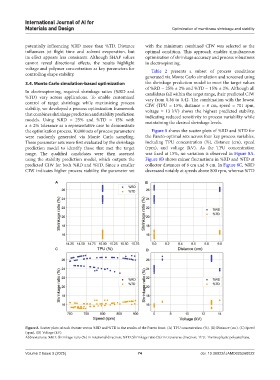
            the optimization process, 10,000 sets of process parameters   Figure 8 shows the scatter plots of %RD and %TD for
            were randomly generated via Monte Carlo sampling.   the Pareto-optimal sets across four key process variables,
            These parameter sets were first evaluated by the shrinkage   including  TPU  concentration (%),  distance  (cm),  speed
            prediction model to  identify those  that  met the  target   (rpm), and voltage (kV). As the TPU concentration
            range. The qualified candidates were then assessed   was fixed at 15%, no variation is observed in Figure 8A.
            using the stability prediction model, which outputs the   Figure 8B shows minor fluctuations in %RD and %TD at
            predicted CIW for both %RD and %TD. Since a smaller   collector distances of 8 cm and 9 cm. In Figure 8C, %RD
            CIW indicates higher process stability, the parameter set   decreased notably at speeds above 800 rpm, whereas %TD


                         A                                     B


                         C                                     D


            Figure 8. Scatter plots of each feature versus %RD and %TD in the results of the Pareto front. (A) TPU concentration (%). (B) Distance (cm). (C) Speed
            (rpm). (D) Voltage (kV).
            Abbreviations: %RD: Shrinkage ratio (%) in rotational direction; %TD: Shrinkage ratio (%) in transverse direction; TPU: Thermoplastic polyurethane.


            Volume 2 Issue 3 (2025)                         74                        doi: 10.36922/IJAMD025260022

