


Page 78 - IJAMD-2-3
P. 78
International Journal of AI for
            Materials and Design                                          Optimization of membrane shrinkage and stability


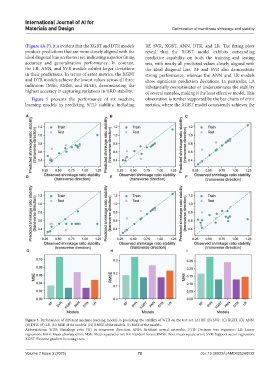
            (Figure 4A-F), it is evident that the XGBT and DTR models   RF, SVR, XGBT, ANN, DTR, and LR. The fitting plots
            produce predictions that are more closely aligned with the   reveal that the XGBT model exhibits outstanding
            ideal diagonal line on the test set, indicating superior fitting   predictive capability on both the training and testing
            accuracy  and  generalization  performance.  In  contrast,   sets, with nearly all predicted values closely aligned with
            the LR, ANN, and SVR models exhibit larger deviations   the ideal diagonal line. RF and SVR also demonstrate
            in their predictions. In terms of error metrics, the XGBT   strong performance, whereas the ANN and LR models
            and DTR models achieve the lowest values across all three   show significant prediction deviations. In particular, LR
            indicators (MSE, RMSE, and MAE), demonstrating the   substantially overestimates or underestimates the stability
            highest accuracy in capturing variations in %RD stability.  of several samples, making it the least effective model. This

              Figure  5 presents the performance of six machine   observation is further supported by the bar charts of error
            learning models in predicting %TD stability, including   metrics, where the XGBT model consistently achieves the

            A                                   B                               C


            D                                   E                               F


            G                                   H                               I


            Figure 5. Performance of different machine learning models in predicting the stability of %TD on the test set. (A) RF. (B) SVR. (C) XGBT. (D) ANN.
            (E) DTR. (F) LR. (G) MSE of the models. (H) RMSE of the models. (I) MAE of the models.
            Abbreviations: %TD: Shrinkage ratio (%) in transverse direction; ANN: Artificial neural networks; DTR: Decision tree regressor; LR: Linear
            regression; MAE: Mean absolute error; MSE: Mean squared error; RF: Random forest; RMSE: Root mean square error; SVR: Support vector regression;
            XGBT: Extreme gradient boosting trees.


            Volume 2 Issue 3 (2025)                         72                        doi: 10.36922/IJAMD025260022

