


Page 75 - IJAMD-2-3
P. 75
International Journal of AI for
            Materials and Design                                          Optimization of membrane shrinkage and stability


            (vi) Step 6: Pareto front construction             XGBT exhibit high prediction accuracy, as evidenced by the
               The feasible samples are mapped onto a Pareto front   close alignment of predicted values with the ideal diagonal
               by jointly considering two competing objectives:   line on both training and test sets, indicating strong
               Shrinkage deviation from the target values and the   generalization capability across varying input conditions.
               predicted CIW (robustness). This multi-objective   The ANN, DTR, and LR models display noticeably larger
               optimization framework enables the identification of   deviations from the ground truth, suggesting the presence
               trade-offs between dimensional accuracy and process   of underfitting, model bias, or limited capacity to capture
               stability, guiding informed decision-making rather   the complex, non-linear relationships inherent in the
               than relying on a single metric.                dataset. Notably, certain predicted %RD values correspond
            (vii) Step 7: Optimal parameter selection.         to multiple experimentally observed outcomes. This
               Based on the Pareto front constructed in Step 6,   phenomenon does not originate from predictive ambiguity
               the optimal processing configuration is selected by   in the models but rather reflects the intrinsic instability of
               prioritizing the lowest CIW to maximize stability while   the electrospinning process itself. The shrinkage ratios are
               maintaining an acceptable deviation from the target   susceptible to fluctuations arising from subtle variations
               shrinkage ratios, ensuring dimensional precision.   in ambient environment, equipment status, and material
               This integrated approach effectively balances product   heterogeneity, all of  which can  introduce  non-negligible
               quality with manufacturing consistency, providing   noise into the output. Such variability highlights the
               a practical and reliable processing window for   necessity of  incorporating both accuracy and  stability
               electrospinning applications.                   into the modeling framework to ensure reliable shrinkage
                                                               control.
            3. Results and discussion
                                                                 Figure  3 presents the performance of six machine
            3.1. Shrinkage ratio prediction model              learning models in predicting %TD, including RF, SVR,
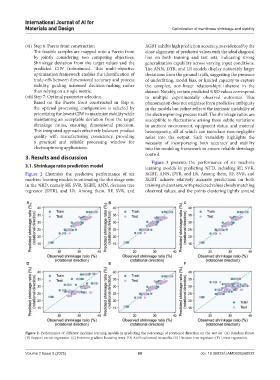
            Figure  2  illustrates the predictive performance of six   XGBT, ANN, DTR, and LR. Among them, RF, SVR, and
            machine learning models in estimating the shrinkage ratio   XGBT achieve  relatively accurate predictions  on both
            in the %RD, namely RF, SVR, XGBT, ANN, decision tree   training and test sets, with predicted values closely matching
            regressor (DTR), and LR. Among them, RF, SVR, and   observed values, and the points clustering tightly around

            A                                  B                               C


            D                                  E                               F


            Figure 2. Performance of different machine learning models in predicting the percentage of rotational direction on the test set. (A) Random forest.
            (B) Support vector regression. (C) Extreme gradient boosting trees. (D) Artificial neural networks. (E) Decision tree regressor; (F) Linear regression.


            Volume 2 Issue 3 (2025)                         69                        doi: 10.36922/IJAMD025260022

