


Page 76 - IJAMD-2-3
P. 76
International Journal of AI for
            Materials and Design                                          Optimization of membrane shrinkage and stability


                A                              B                               C


             D                                 E                                F


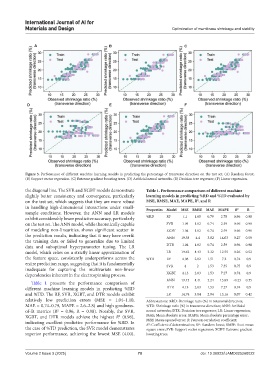
            Figure 3. Performance of different machine learning models in predicting the percentage of transverse direction on the test set. (A) Random forest.
            (B) Support vector regression. (C) Extreme gradient boosting trees. (D) Artificial neural networks. (E) Decision tree regressor; (F) Linear regression.

            the diagonal line. The SVR and XGBT models demonstrate   Table 1. Performance comparison of different machine
            slightly better consistency and convergence, particularly   learning models in predicting %RD and %TD evaluated by
                                                                                     2
            on the test set, which suggests that they are more robust   MSE, RMSE, MAE, MAPE, R , and R
            in handling high-dimensional interactions under small-  Properties  Model  MSE  RMSE  MAE  MAPE  R 2  R
            sample conditions. However, the ANN and LR models
            exhibit considerably lower predictive accuracy, particularly   %RD  RF  1.1  1.05  0.79  2.78  0.96  0.98
            on the test set. The ANN model, while theoretically capable   SVR  1.04  1.02  0.74  2.59  0.96  0.98
            of modeling non-linearities, shows significant scatter in   XGBT  1.04  1.02  0.74  2.59  0.96  0.98
            the prediction results, indicating that it may have overfit   ANN  19.38  4.4  3.82  14.03  0.27  0.59
            the training data or failed to generalize due to limited
            data and suboptimal hyperparameter tuning. The LR           DTR   1.04  1.02  0.74  2.59  0.96  0.98
            model, which relies on a strictly linear approximation of   LR    19.62  4.43  3.32  12.55  0.26  0.52
            the  feature space, consistently underperforms  across  the   %TD  RF  4.08  2.02  1.51  7.2  0.74  0.9
            entire prediction range, suggesting that it is fundamentally   SVR  4    2   1.53  7.35  0.75  0.9
            inadequate for capturing the multivariate non-linear
            dependencies inherent in the electrospinning process.       XGBT  4.13  2.03  1.53  7.27  0.74  0.9
                                                                        ANN   19.45  4.41  3.24  13.89  -0.23  0.35
              Table 1 presents the performance comparison of
            different machine learning models in predicting %RD         DTR   4.13  2.03  1.53  7.27  0.74  0.9
            and %TD. The RF, SVR, XGBT, and DTR models exhibit          LR    14.74  3.84  2.94  13.16  0.07  0.42
            relatively low prediction errors (MSE = 1.04–1.10,   Abbreviations: %RD: Shrinkage ratio (%) in rotational direction;
            MAE = 0.74–0.79, MAPE = 2.6–2.8) and high goodness-  %TD: Shrinkage ratio (%) in transverse direction; ANN: Artificial
            of-fit metrics (R  = 0.96, R = 0.98). Notably, the SVR,   neural networks; DTR: Decision tree regressor; LR: Linear regression;
                         2
            XGBT, and DTR models achieve the highest  R   (0.96),   MAE: Mean absolute error; MAPE: Mean absolute percentage error;
                                                    2
            indicating excellent predictive performance for %RD. In   MSE: Mean squared error; R: Pearson correlation coefficient;
                                                                2
                                                               R : Coefficient of determination; RF: Random forest; RMSE: Root mean
            the case of %TD prediction, the SVR model demonstrates   square error; SVR: Support vector regression; XGBT: Extreme gradient
            superior performance, achieving the lowest MSE (4.00),   boosting trees.

            Volume 2 Issue 3 (2025)                         70                        doi: 10.36922/IJAMD025260022

